
Who can afford to comply with EU sustainability rules?
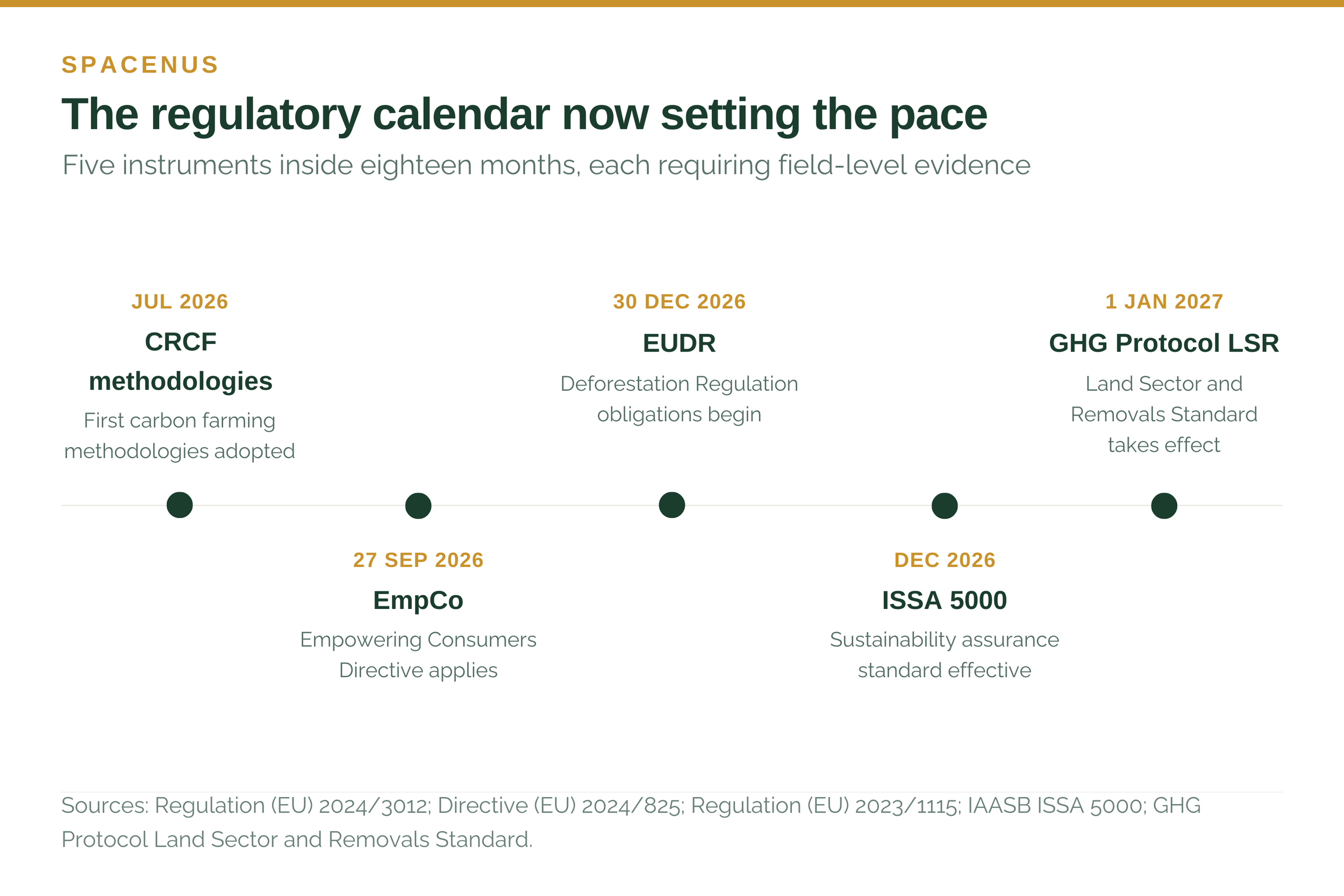
EU sustainability rules pursue objectives worth pursuing, and the deforestation EUDR targets is real. They also apply broadly flat compliance costs to suppliers whose administrative capacity to absorb them differs enormously, which is a design question rather than an argument against the regulation. EUDR obligations begin on 30 December 2026 for large and medium operators, and 30 June 2027 for micro and small enterprises outside timber, with no further postponement confirmed.
Start with the case for the regulation
It is worth stating properly rather than as a concession, because it is strong.
The deforestation the EUDR targets is real and substantial. Emissions from land use change are among the largest unaccounted environmental costs in global food production. The EU has a defensible interest in ensuring its own consumption does not drive them, and voluntary approaches had two decades to work.
As a company whose business exists because environmental claims should be verifiable, we are not neutral on this. Better standards are the right direction. The question is how the cost of meeting them is distributed, which is a design question, not an argument against the objective.
Flat cost, unequal capacity
The EUDR requires that cocoa, soy, palm oil, beef, coffee and timber entering the EU carry geo-referenced evidence of not originating on land deforested after December 2020. Reasonable requirement. The cost of building traceability infrastructure to satisfy it is broadly independent of operation size.
A cooperative of three thousand smallholders in Côte d’Ivoire faces the same documentation obligation as a large industrial operation, with a fraction of the administrative capacity and none of the technology infrastructure.
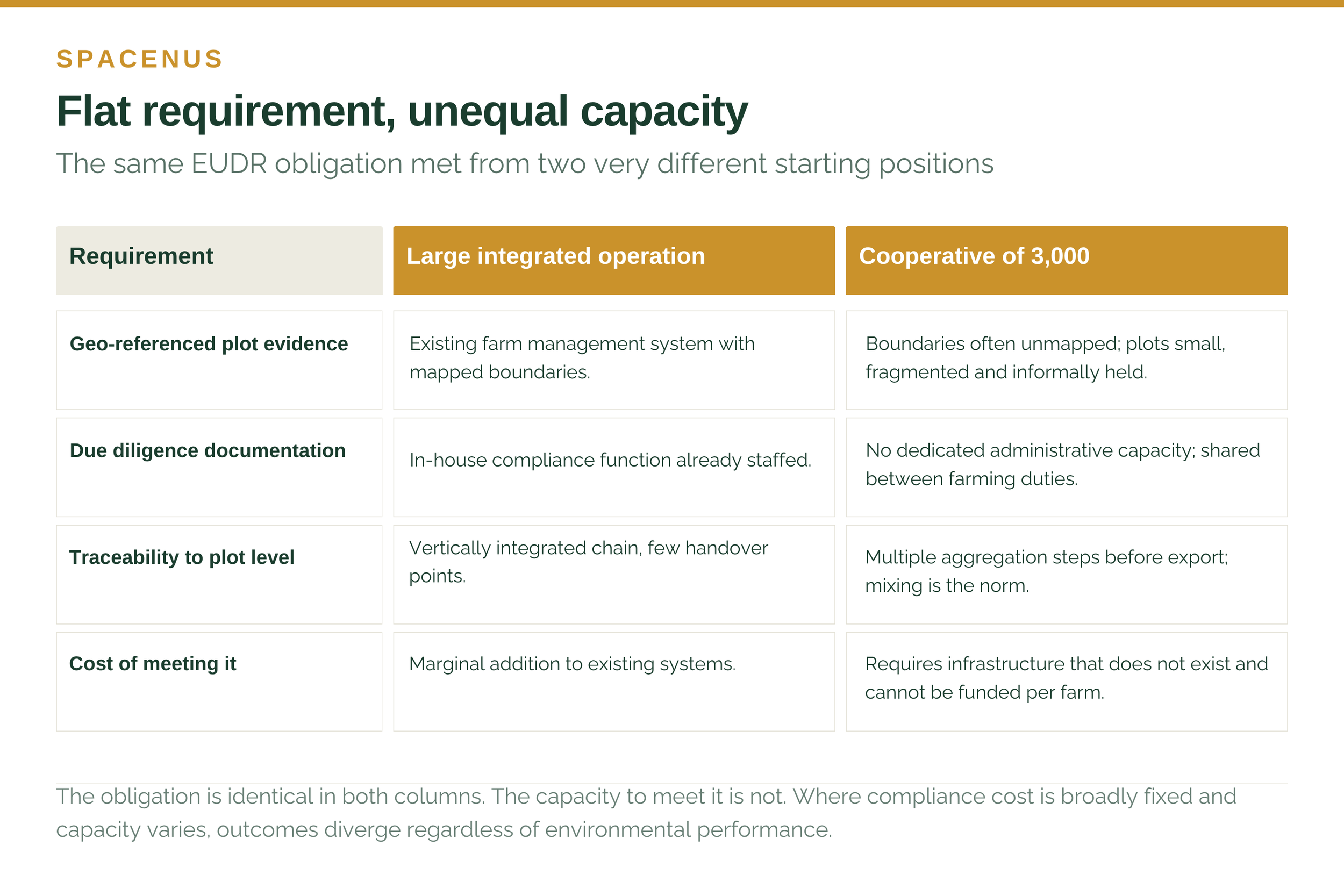
When cost is flat and capacity is not, a requirement does not level a field. The predictable outcome is that large, vertically integrated suppliers in regions with established agri-tech infrastructure comply more readily, while fragmented supply bases in producing countries struggle — and the certificate ends up correlating with compliance capacity rather than with environmental outcome.
The producer-country response
This has been raised formally rather than only in commentary. Ghana, Côte d’Ivoire and Indonesia, collectively producing the majority of the world’s cocoa and palm oil, filed a joint statement objecting that the regulation creates compliance barriers falling disproportionately on smallholders who had no role in the deforestation it targets. Colombia has characterised CBAM in strong terms in WTO proceedings.
We are not adjudicating that. The objections are a matter of record and they identify a real distributional effect. It is also true that producer-country governments have their own interests, and that some objections serve incumbents rather than smallholders.
The point that survives from both sides is narrower and harder to argue with: a standard designed in Brussels by institutions that do not depend on palm oil for rural employment will not look the same as one designed in Jakarta. Treating harmonisation as purely technical, or assuming all parties begin from equal interest, is how these conversations stall.
Three things food companies can actually do
1. Build on field primitives, not on a specific regulation
The Omnibus revision of CSRD scope and successive EUDR implementation delays both show that compliance strategies designed around one regulation are fragile, optimised for a political settlement that is already moving.
Capturing GPS-located, timestamped physical facts that can be translated into whatever framework applies is the only approach that survives regulatory change. When the rule shifts, you update the translation rather than re-surveying the supply base.
2. Treat supplier development as commercial self-interest
If your supply chain includes smallholders who cannot independently navigate your compliance requirements, they will be replaced by larger producers who can. That is worse for supply chain resilience, worse for supplier diversity, and quite possibly worse environmentally, since consolidation is not obviously an ecological improvement.
Companies that invest in compliance capacity among smaller suppliers end up with better data and more durable relationships. This is not philanthropy; it is protecting a supply base you will otherwise lose.
3. Pursue interoperability, not harmonisation
Global convergence of sustainability standards is not arriving soon. Interoperability is achievable now: systems translating the same underlying field data into each jurisdiction’s required format without the farmer managing the translation. That is a technology and data governance problem, and it does not require waiting on diplomacy.
What good regulation would look like
If the objective is environmental outcome rather than documentary compliance, then verification cost has to fall far enough that capacity stops determining who can participate. That is largely a technology question and it is being answered — continuous satellite monitoring costs single-digit euros per farm per year where a physical audit costs hundreds.
The regulatory contribution would be to recognise passively captured evidence as sufficient where it genuinely is, rather than requiring a human signature on things a sensor observes more reliably. That change would do more for smallholder inclusion than any amount of transition support.
Spacenus builds field-level evidence decoupled from any single framework, as an independent verifier rather than a programme operator. Where it is useful, that architecture is what lets a smallholder supply base meet requirements designed without it in mind.
Common questions
Is EU sustainability regulation protectionist?
That framing is contested and we would not assert it. What is observable is that flat compliance costs applied to suppliers of unequal capacity produce unequal outcomes, which is a distributional effect whether or not it was intended.
What is the EUDR requirement in practice?
Geo-referenced evidence that specified commodities entering the EU did not originate on land deforested after December 2020, supported by due diligence documentation.
How can smallholder supply chains realistically comply?
Through aggregation and shared infrastructure rather than farm-by-farm documentation. Satellite-derived land use evidence covers a whole supply base at a cost that per-farm auditing cannot approach.
Why build on field primitives rather than to the regulation?
Because regulations change. CSRD scope narrowed in 2026 and EUDR timelines have moved repeatedly. Data captured as raw physical fact can be re-translated; data captured in one framework’s report format cannot.