
We make agricultural sustainability claims verifiable - and we verify nothing we own.
Spacenus GmbH was founded in 2015 in Darmstadt, Germany, and has spent ten years developing satellite agricultural verification with the European Space Agency, the German Federal Ministry of Education and Research and Distr@l Hessen. All intellectual property is owned by Spacenus. The company verifies programmes designed and operated by others, and its revenue does not vary with the measured outcome. It issues no carbon credits, runs no farmer programmes, sets no standard and holds no verification body accreditation.
About Spacenus
HQ
Darmstadt, Germany
Technology
ESA co-developed, BMBF co-funded
All IP owned by Spacenus
Founded
2015
Operating in
Germany (HQ), the EU, the UK, India, Pakistan, and Bangladesh.
67 %
pilot-to-programme conversion rate across projects.
< 5%
MRV cost as a percentage of credit revenue per ha.
30k+
data points for sat. image calibration and validation.
10 years
ESA-supported co-development & Innovation
“The verification problem in farming is fundamentally a remote sensing problem.”
— Riazuddin Kawsar, CEO, Spacenus
WHY WE EXIST
Make regenerative agriculture provable, and worth it, for everyone in the chain.
Mission: Make regenerative agriculture provable, and worth it, for everyone in the chain.
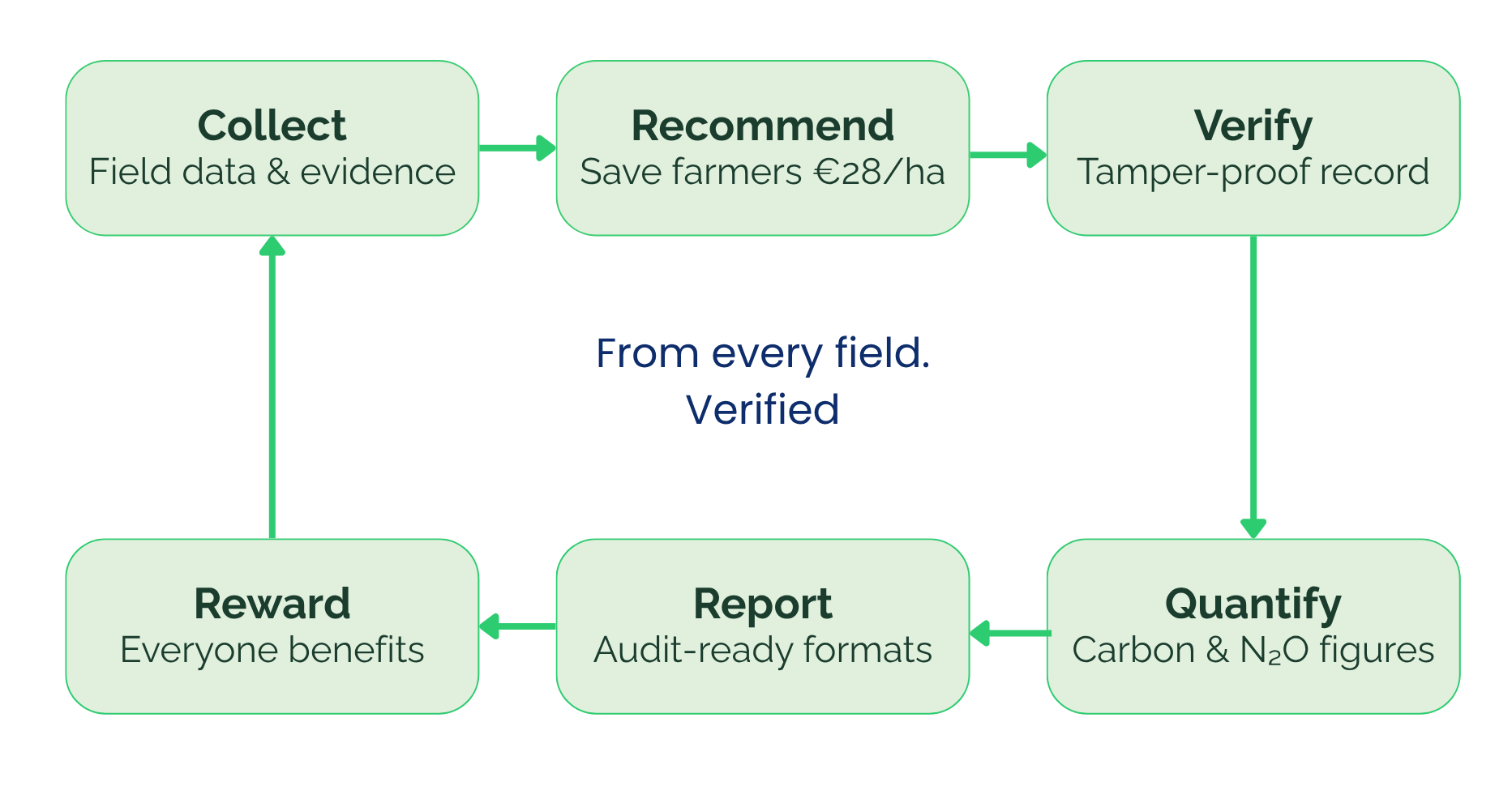
Promise: From every field. Verified.
How? - The Loop
STRUCTURAL INDEPENDENCE
The most credible verification is the kind with nothing to gain from the answer.
Every integrated carbon programme operator, companies that design programmes, engage farmers, and then verify their own programmes, has a financial interest in the verification outcome. If more credits pass, they earn more. If more practices are verified, they retain more farmers.
Spacenus has no such interest. We verify programmes designed and operated by others. Our revenue comes from selling verification services, not from the outcomes of verification. Under the EU Carbon Removal Certification Framework, this structural independence is not just a positioning choice. It is a legal requirement. Independence is not the reason to buy - it is the reason the evidence is accepted. What you buy is fewer duplicated audits, lower MRV cost, and claims that survive scrutiny. No offsetting credits to sell. No insetting programmes to defend. No conflict of interest."
A financial audit firm
Audits companies it does not own. Independence is the source of the credibility.
A product certification body
Certifies quality for manufacturers it has no stake in. No conflict, no reason to doubt the result..
Spacenus
Verifies programmes and supply chains it has no stake in. Structural independence is what makes the certificate relied upon.
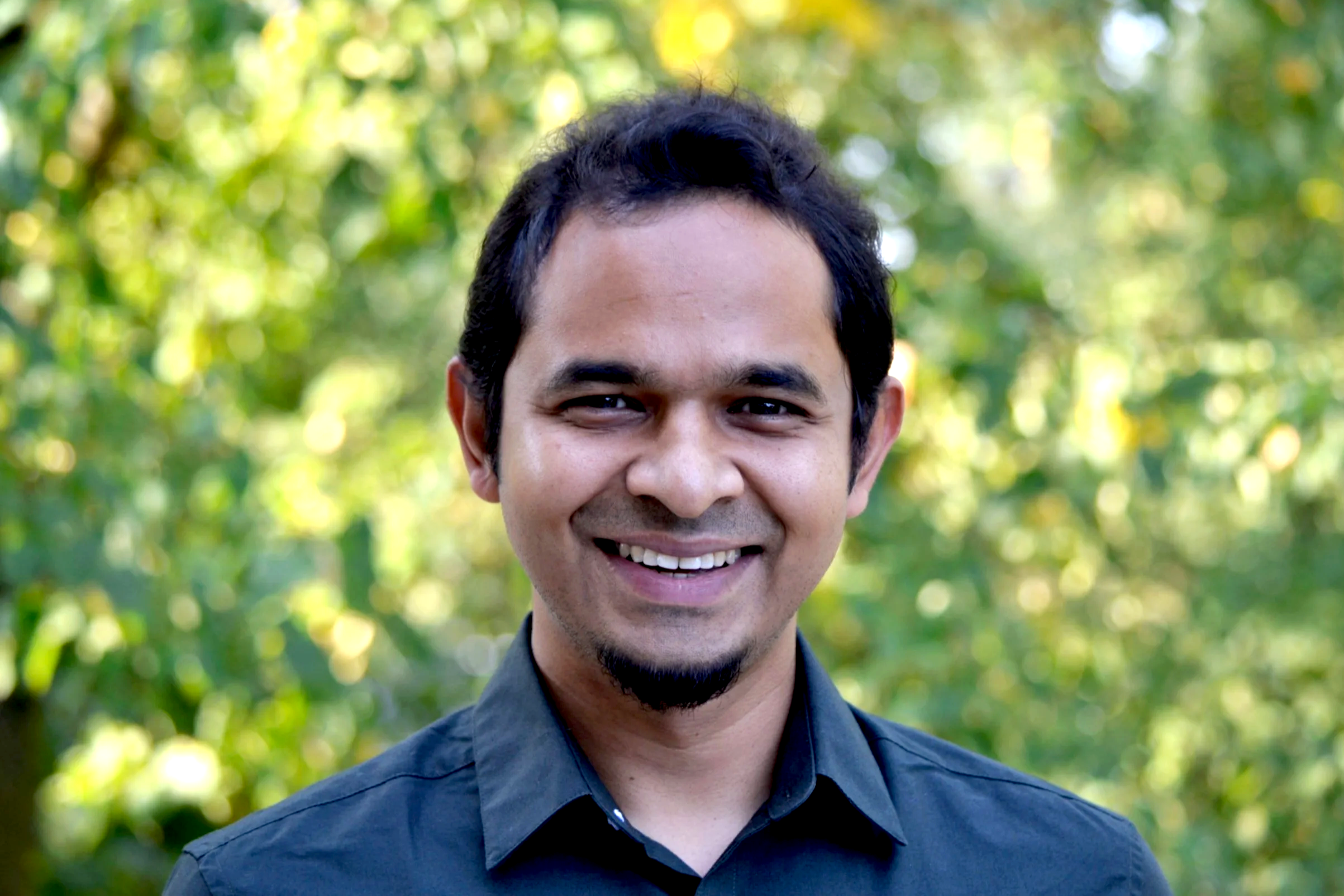
Spacenus CEO, Riazuddin Kawsar has spent nearly two decades using satellite data to reveal what cannot be seen from the ground, mapping land cover in inaccessible terrain, managing hundreds of field surveyors, and building databases organizations used to make consequential decisions.
The direction for Spacenus came from his MSc thesis at the University of Münster: modelling climate stress and armed conflict. The conclusion was precise, resource scarcity is a statistically significant predictor of political instability. That pointed directly at agriculture. He founded Spacenus to work at the root: making regenerative farming economically viable by making its claims verifiable.
Before founding Spacenus, he spent five years with agricultural input manufacturers, which gave him an unusually clear view of why verification fails: not because the science is inadequate, but because those with a financial interest in the outcome control the evidence. That structural problem became the founding principle of Spacenus.
Born in Bangladesh, based in Germany, and operating across Europe and Asia, he brings a perspective that is rare in the AgTech space: a first-hand understanding of what agricultural failure looks like in fragile geographies, and the technical capacity to build something that might prevent it.
Built with and validated by the institutions that matter.
ESA / DLR / K+S
European Space Agency together with K+S, Göttingen & Giessen University · SatMRV · SIITAg · DASF · GFaaS · All IP owned by Spacenus
BMBF / Distr@l Hessen
German Federal Ministry of Education & Research · FUSION all-weather model · Hessen Distr@l · BMBF Sustainability Index India
TU Berlin / IIT Ropar
Co-development of BMBF Sustainability Index for India & EU· Multi-crop assessment · Europe & South Asia agricultural landscapes
Copernicus / BIC Hessen
Business Innovation Centre · Commercialisation support for ESA-co-developed technology · Institutional partner for growth.
Ready to see what Spacenus integrates into your programme or supply chain?
Talk to our team. We will show you exactly how Spacenus integrates into your programme, supply chain, or reporting workflow.
-
No. Spacenus holds no accreditation under ISO 14065 or ISO/IEC 17029 and is not a Validation or Verification Body. Accredited bodies remain the verifiers of record. Spacenus produces the independent MRV evidence those bodies validate, and never certifies against a standard.
-
Since 2015, from Darmstadt in Germany. Ten years of development co-funded by the European Space Agency, the German Federal Ministry of Education and Research and Distr@l Hessen, with all intellectual property owned by Spacenus. In a market where one provider has closed and several better-funded competitors are five to seven years old, that is itself a procurement signal.
-
Six questions. Does the provider's revenue vary with the measured outcome? Are quantification and commercialisation in one entity? What share of the figure rests on physical measurement? Is uncertainty quantified at the level of the claim? Can field-level evidence be retrieved three years later? Is the methodology version-controlled? Spacenus publishes its own answers first.