
The Farmer Is Not Your Data Vendor
Farmers generate the primary environmental data underpinning corporate sustainability disclosure, green finance and carbon markets, carry much of the verification cost, and capture a minority of the value in most aggregated programmes. Three counter-arguments deserve weight: aggregation creates the market, verification genuinely costs money, and farmers do receive agronomic benefit. None explains why the data layer itself should be owned by the parties consuming it. Spacenus sits inside this economy, not outside it.
Quotations from farmers and supply chain participants in this article are unattributed by agreement. We paraphrase rather than invent, and we do not publish wording the speaker has not seen.
Why this is a data quality problem, not only an equity one
It would be easy to file this under fairness and move on. The reason it belongs on a verification company’s website is narrower: data quality is a function of the incentive to produce it.
When the person generating a measurement is not compensated for its accuracy or completeness, quality degrades — quietly, incrementally, and long before it surfaces anywhere a board would notice. Every assurance opinion built on top of that data inherits the problem.
The cost side, which is measurable
Research from the Climate Policy Initiative puts the cost of monitoring, reporting and verification for a smallholder or mid-sized farm in a sustainability programme at roughly €100–200 per farm per year. The time burden sits on top of that — portal logins, questionnaires, cooperating with audit visits — in hours not spent farming.
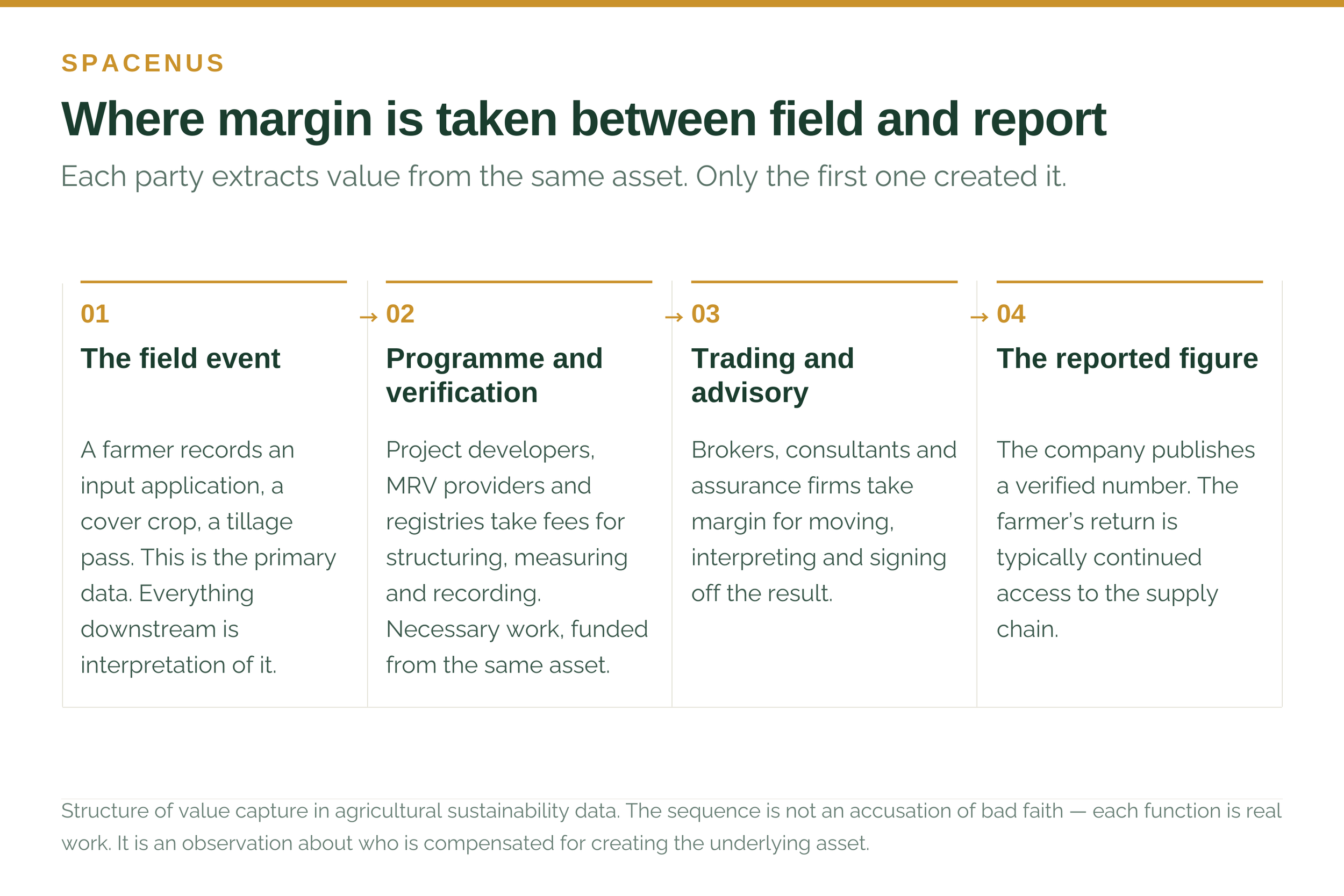
Against that cost, carbon revenue is the mechanism most often cited as the reward. For smallholder and mid-scale farmers in aggregated programmes, revenue after project developer fees typically lands well below what the same credit fetches when it reaches a corporate buyer. The spread varies substantially by programme and geography, and some European operators pay considerably better than others — but in the arrangements where the gap is widest, the farmer captures a minority share of the value her land created.
Where the money in this system actually goes
The value of farm data to a company is easier to locate than to price. It satisfies CSRD and GHG Protocol LSR reporting obligations. It supports sustainability-linked finance, where lending terms are tied to verified performance. It underpins consumer claims that carry a brand premium. And it is the difference between an assurance opinion a company can publish and one it cannot.
What is easier to compare is the money circulating around that data against the money reaching its source. Global spend on ESG advisory and sustainability consulting is estimated in the region of forty-eight billion dollars. The global insetting market, the primary mechanism through which money flows back to farms, is projected at roughly ten billion.
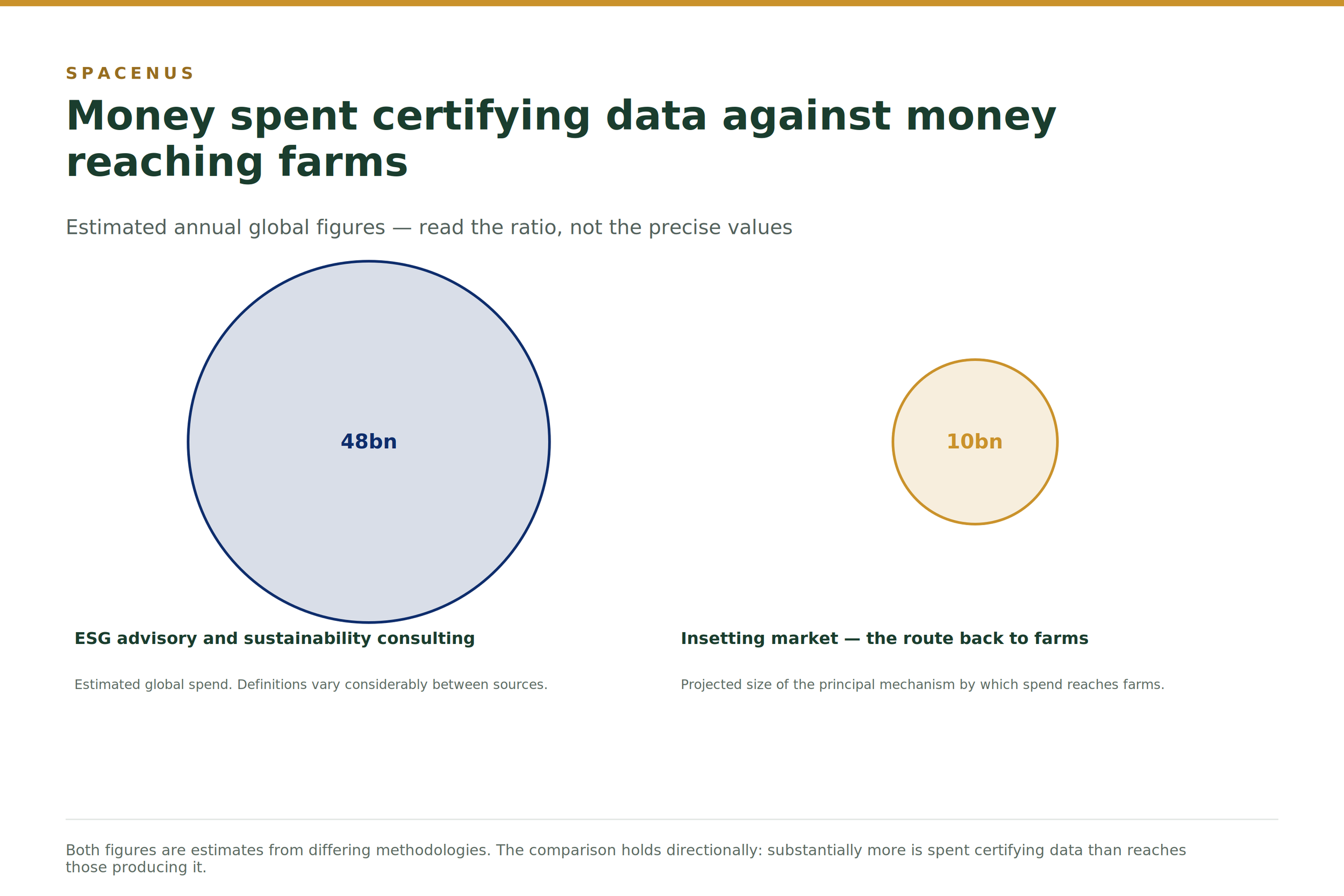
Both figures are soft and definitions differ, so treat the ratio rather than the values. Roughly five times more is being spent certifying that the data exists than is flowing to the people producing it.
“A mid-scale arable farmer put it to us at a supply chain forum, in words we are paraphrasing because the conversation was not on the record: they generate the data behind the buyer’s green bond, and their reward is staying on the approved supplier list.” — Paraphrased with permission, name withheld by agreement
Three counter-arguments, taken seriously
Farmers benefit from the practices themselves
True. Better soil health means lower input costs, improved drought resilience and steadier yields. But those benefits arrive over five to ten years while the data and transition costs are incurred now. The J-curve is real and most farms cannot finance it alone.
Market access is the incentive
Also true, and it is not a payment. If the cost of compliance approaches the margin it protects, it functions as a cost of remaining in the market rather than an opportunity. Framing it as a partnership does not change the cash flow.
Insetting programmes already pay
Some do, genuinely. A number of large food companies run substantive programmes and deserve credit for them. The issue is scale: the mechanism reaching farms is an order of magnitude smaller than the mechanism certifying that the data exists.
What remediation would actually require
Data ownership treated as real. A farmer’s soil measurements, input records and yield history are assets. The EU Data Act establishes that users of connected devices have rights to the data those devices generate. That principle needs applying in agricultural contracts, not left as legal abstraction.
Transition finance. The three-to-five-year window while a farm moves toward verified practice is when costs peak and revenues dip. Carbon credits take years to materialise and cannot fund it. Direct payment - from retailers, lenders and public budgets, proportional to the benefit those parties will receive.
Automated MRV. Every hour spent logging data into a portal is an hour not farming. Satellite monitoring, soil sensors and tractor telematics can capture most verification data without manual entry. The farmer should not be the data clerk of a multi-billion-euro compliance system.
Of those three, the last is the one a technology company can actually deliver, and it is the reason we build the way we do. If the evidence can be captured passively, the burden argument largely disappears, and the quality argument improves at the same time, because passively captured data does not depend on somebody remembering.
Why we are writing this
Spacenus sits inside the verification economy described above. We are paid to verify agricultural claims, which means we are part of the forty-eight billion rather than the ten. Writing this without saying so would be dishonest.
Two things follow from that position rather than despite it. Our nitrogen product is designed so the farmer gains before anyone asks her for data — the recommendation saves input cost, and the verified data is a by-product of her using it. And we build for automated capture rather than farmer data entry, because a system depending on unpaid administrative labour from its primary data source is not a stable system.
That does not resolve the imbalance. It does mean we are not adding to it.
ANA delivers satellite-calibrated nitrogen recommendations that reduce input cost for the farmer first, with verified field data arriving as a consequence rather than a requirement. There is more on the farmer-facing side of this at ana.farm.
Common questions
What does farm-level MRV cost a farmer?
Climate Policy Initiative research puts direct cost at roughly €100–200 per farm per year for smallholder and mid-sized operations in sustainability programmes, before accounting for the farmer’s own time.
Why do farmers receive so little of the carbon credit price?
Project development, verification, registry fees and brokerage each take margin between the field and the buyer. The share reaching the farm varies widely by programme; aggregated smallholder projects tend to retain the least at farm level.
Does the EU Data Act help farmers?
It establishes that users of connected devices have rights to the data those devices generate, which is directly relevant to farm machinery and sensors. Whether it changes outcomes depends on how aggressively it is applied in supply contracts.
What is insetting?
Emission reductions achieved inside a company’s own supply chain rather than purchased externally as offsets. It is the main route by which sustainability spending reaches the farms generating the underlying data.