
FOR CARBON PROGRAMME DEVELOPERS
MRV infrastructure that makes your programme economically viable.
Most carbon programmes fail on monitoring, reporting and verification economics rather than on methodology. Spacenus supplies independent MRV at under 5% of credit revenue per hectare, with registry-compliant soil carbon baselines, three to five year credit-volume trajectories and tamper-resistant practice certificates. Under the EU Carbon Removal Certification Framework, certification requires an independent verifier and ISO 17065-accredited bodies, so a programme operator cannot self-supply verification. Spacenus develops no programmes, recruits no farmers and sells no credits.
THE CHALLENGE
Most carbon programmes fail on MRV economics - not methodology.
MRV costs kill programme economics
Traditional MRV approaches consume 25–50% of carbon project budgets. At that cost, most programmes cannot reach the scale needed to survive as a business. The technology exists; the cost model is broken.
CRCF requires independence you cannot self-issue
The EU CRCF legally requires verification by an independent party, not by the entity that operates the programme. Integrated operators face a structural conflict of interest. You need a verifier with no skin in the outcome.
Registry audits are getting stricter
Registry like Verra, Gold Standard, and EU CRCF requirements for tamper-resistant practice evidence have tightened, and a declaration with no independent cross-check carries the audit risk rather than resolving it.
Satellite-only approaches face LSR scrutiny
The GHG Protocol LSR Standard (effective 1 January 2027) requires primary land-sector data with full spatial traceability. Satellite monitoring without a tamper-resistant evidence chain is insufficient. You need triangulation.
HOW SPACENUS SOLVES IT
| What you need | How Spacenus delivers it |
|---|---|
| MRV at <5% of credit revenue | SatMRV brings MRV cost to under 5% of credit revenue per hectare, compared to 25–50% for conventional approaches. The economics work at any programme size. Scale to large hectarage without proportional cost increase. |
| Structural independence, codified in CRCF | Spacenus has no credits to sell and no programmes to defend. Our revenue comes from selling verification services - not from verification outcomes. Under EU CRCF, this structural independence is not a positioning choice. It is a legal requirement and Spacenus is built to meet it. |
| Four-stream tamper-resistant DPP verification (TVM) | The Digital Proof of Practice (DPP) certificate cross-checks four independent streams: plausibility pre-screening + Sentinel-2 satellite time-series + verified geotagged photos + spatial cross-validation. No single stream can be altered without the others detecting it. Already recognised at scale by a major international standard body across global farms. |
| RothC trajectory — financial planning tool | 3–5 year SOC trajectory projections per field enable programme developers to financially plan future credit volumes before committing to programme design. |
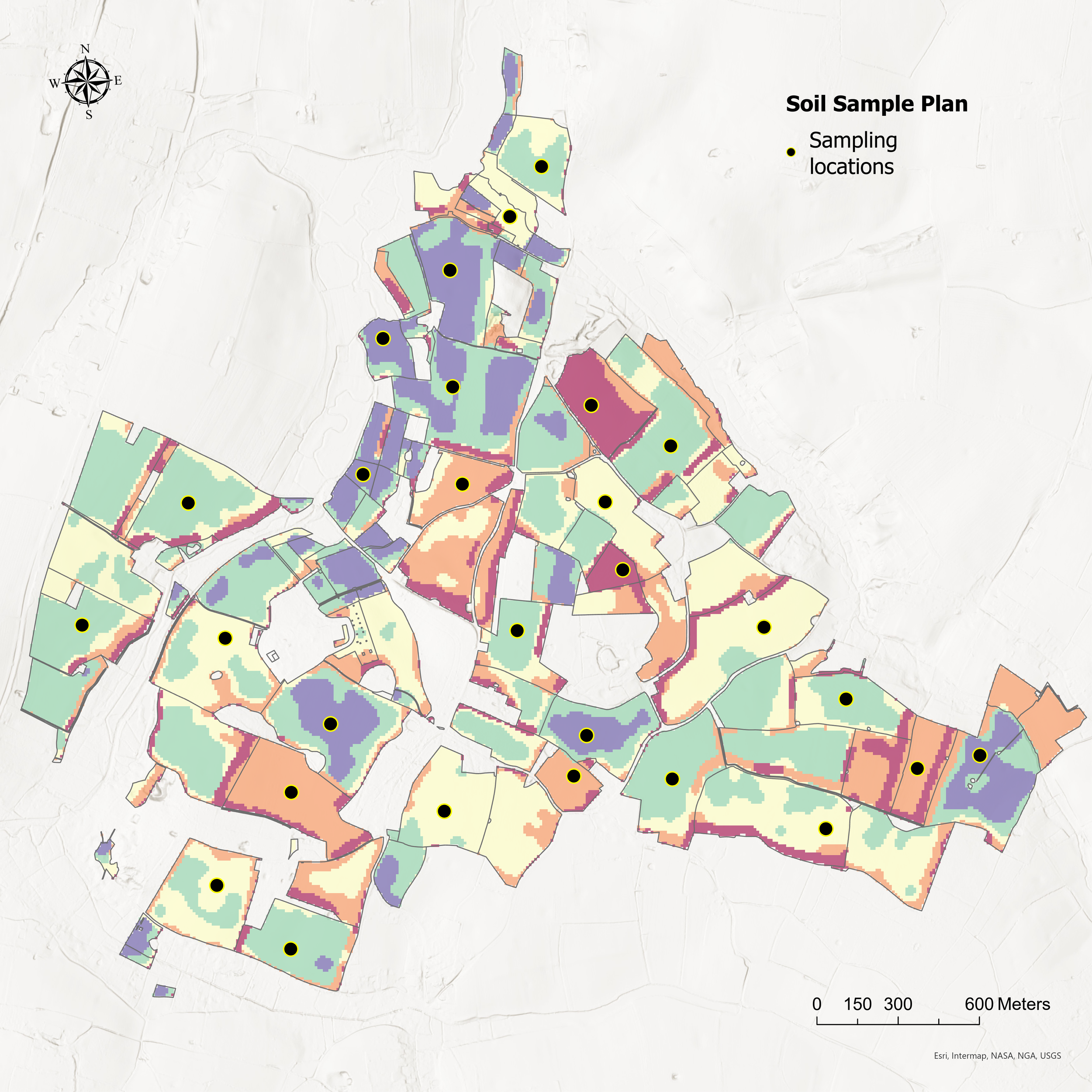
| 50% fewer physical soil samples | Satellite-optimised stratified sampling design reduces physical sample count by up to 50% while maintaining statistical validity. Lower sampling cost. Less farmer burden. Better retention. |
| Farmer onboarding & retention, solved at the platform layer | Your farmers use a conversational evidence assistant (chat + geotagged photos) and ANA nitrogen guidance that saves them +€28/ha. Data quality and retention stop being programme risks, they are platform features. |
| Insetting claims that survive the double-counting question | When your buyers’ auditors ask which tonne served which claim, farmer goodwill is not an answer. A field-level claims ledger (in development) allocates each verified outcome to exactly one claim - insetting, credit, or subsidy, per parcel. CRCF-recognised schemes must run interoperable registries until the Union registry arrives; independent claim allocation is how your programme stays credible across all of them. |
FROM PILOT TO PROGRAMME
In the ESA SatMRV Project, multiple independent carbon programme developers conducted verification pilots across 8,845 hectares of arable farmland in Europe.
MRV cost landed at 4.1% of projected credit revenue - against an industry baseline of 25–50%. The programme advanced to multi-year deployment under Verra VM0042.
These results were produced by an independent verification provider with no financial stake in the credit outcome. That independence is precisely what makes them usable in a registry audit and what separates them from MRV produced by the same entity that operates the programme.
RELEVANT PRODUCTS
SatMRV
Independent SOC MRV & Practice Verification. Delivers registry-ready SOC baseline maps, RothC 5-year trajectory forecasting for credit volume planning, and tamper-resistant DPP certificates - at under 5% of credit revenue per hectare. Verra VM0042 · EU CRCF · GHG Protocol LSR · Gold Standard.
→ Full SatMRV detail
ANA
Optional farmer engagement layer. Deploy ANA nitrogen recommendations to generate primary N₂O data and build farmer trust before the SOC verification phase. Zero friction - farmers benefit without being asked to change practices. Particularly effective for programmes with low initial farmer participation. Delivered inside the same platform your verification runs on, one farmer login, one field record.
→ Full ANA detail
Request a SatMRV pilot for your carbon programme
6–8 weeks. Your fields, your standard. Get actual SOC maps and DPP certificates.
-
No. Spacenus does not develop programmes, recruit farmers or sell credits, and holds no stake in whether a practice change occurred. There is no project pipeline and no credit position, so there is no scenario in which Spacenus bids against a programme it verifies.
-
No. CRCF certification requires an independent verifier and ISO 17065-accredited bodies, so an operator cannot self-supply verification. That is a legal requirement rather than a preference, and it is why an integrated operator needs a party with no interest in the result. Spacenus methodology registration is in preparation.
-
Under 5% of credit revenue per hectare. In the ESA SatMRV pilot it was 4.1% of projected credit revenue across 8,845 hectares. In the programmes Spacenus has assessed, conventional MRV consumed 25 to 50% of project budgets — a different denominator, stated here so the comparison can be checked.
-
Accredited third-party auditors and validation or verification bodies. Spacenus is not one and never becomes one. It supplies the independent MRV evidence and the pre-filled assurance annexes those bodies rely on, which is why the evidence is usable in a registry audit rather than something the registry has to discount.