
The Trust Tax: Paying for Scaffolding
The money spent verifying food sustainability is not waste. It is the installation cost of pricing environmental damage that was externalised for decades. But a trust tax is only justified if it produces real trust and eventually gets cheaper, and most of the current spend reaches intermediaries rather than the farms where practice change happens. The design choices being made now, about who controls the primary data layer, decide who the transition serves, including when that layer is ours.
An installation cost, not a bureaucracy
For fifty years the environmental cost of producing food was invisible. Carbon was free. Water was free. Soil degradation appeared on no balance sheet. The price of a tonne of wheat reflected seed, labour, fuel and logistics, not the water table it drew down or the carbon it released.
The reporting infrastructure now being built - CSRD, SBTi, the ISO standards, the audits, the verification platforms, is the economy’s attempt to make those costs visible and priced. That is internalisation of half a century of externality, and it is expensive by its nature.
Global ESG advisory and sustainability consulting spend is estimated in the region of forty-eight billion dollars. Estimates vary widely because definitions do, but the order of magnitude is not in dispute. In food, where supply chain emissions can exceed 80% of a company’s footprint, the burden is concentrated.
We have been in this phase before
In 1997 the internet was slow, expensive and navigated almost exclusively by specialists. Connecting a business required a technician; making it commercially useful required a consultant. Most board members of large companies had no email address.
The trust infrastructure that makes online commerce work - encryption, identity verification, payment processing, dispute resolution - now costs fractions of a penny per transaction and runs invisibly. Nobody decided it was too expensive. The technology made the expense unnecessary.
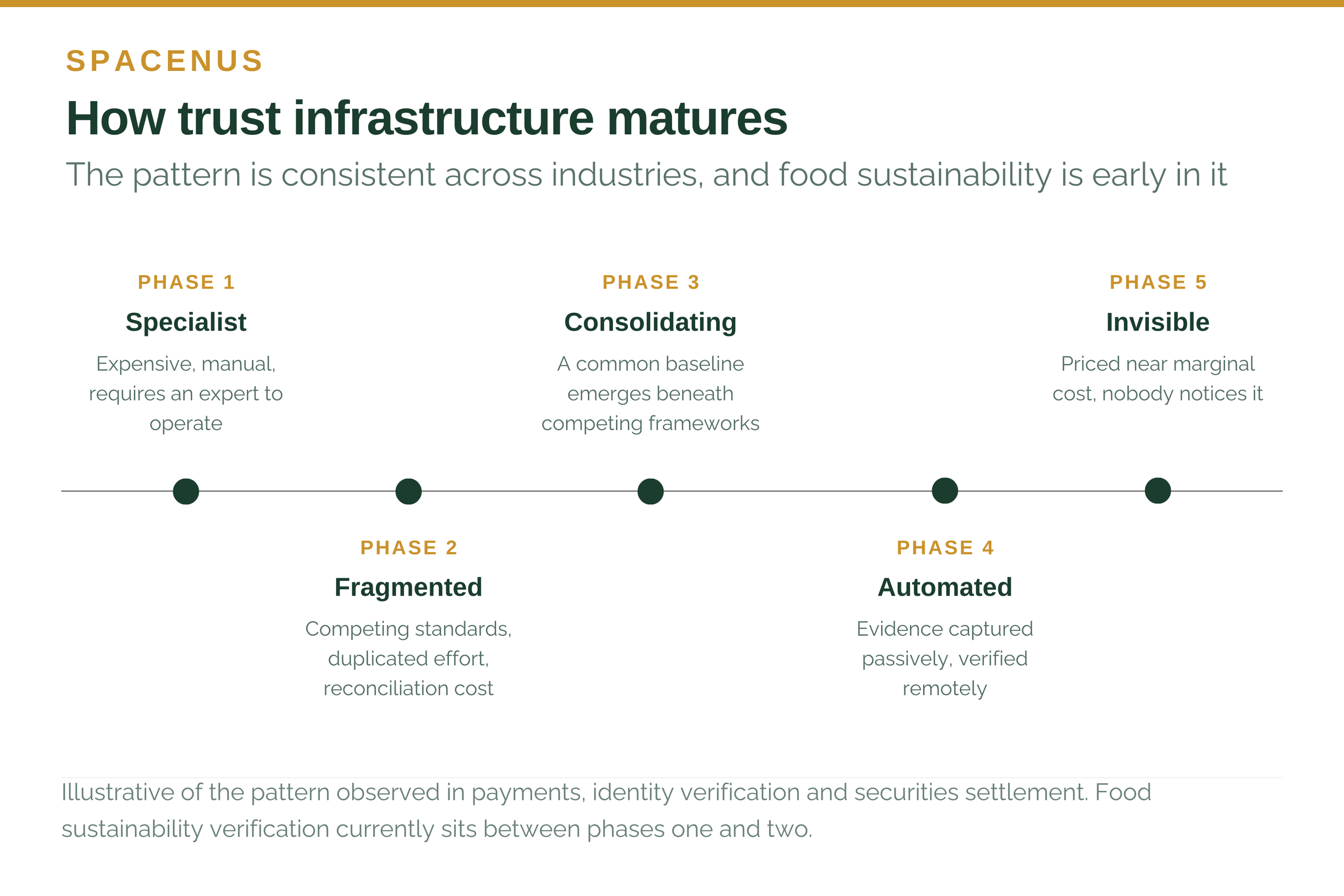
Food sustainability verification is in its 1997 moment. Expensive, manual, fragmented — and building something real. The question worth sitting with is not whether it costs too much. It is what ends the phase.
Three conditions
1. Autonomous verification replaces manual verification
Satellite monitoring of land use change, cover crop establishment and vegetation stress is already more comprehensive than any sample audit programme. Soil sensors and tractor telematics can capture applications and tillage automatically, without a portal login or an auditor visit.
When those passive streams are accepted by standard bodies as primary evidence, without a human auditor co-signing, verification cost for the most common compliance requirements falls dramatically. The technology is ready. The assurance profession is not yet, and that is the actual bottleneck.
2. A durable interpretive baseline emerges
Not global harmonisation of all standards, which is decades away. Something smaller: a common vocabulary for raw field events that major frameworks agree to accept as input. If a field primitive is collected to this specification and verified to this accuracy standard, it is valid input for any of the following frameworks.
That is far more achievable than full convergence, and it removes the need to re-collect data every time a standard shifts. The Omnibus revision, which in 2026 narrowed the number of companies inside mandatory CSRD reporting by a large margin, is a signal worth reading carefully. Standards designed for comprehensiveness without a built-in cost-reduction path attract political backlash. Durability requires affordability.
3. The producer economics have to work
In the current arrangement the farmer receives continued market access in exchange for data compliance. That is not a payment structure that scales. Insetting, data licensing, procurement premiums and transition finance together need to make participation economically self-reinforcing rather than an obligation absorbed as the cost of staying listed.
“A verification system that depends on net-negative economics for its primary data source is not a system. It is a countdown.” — Spacenus team
The design matters as much as the arrival
There is a warning in the analogy that is easy to skip past. Airbnb built its trust infrastructure on the premise of enabling small hosts — ordinary people renting spare rooms. What emerged over time was a system increasingly dominated by professional operators, with rising prices and regulatory conflict city by city. Infrastructure meant to democratise became a mechanism for concentration.
The equivalent risk here is visible already. If autonomous monitoring is deployed principally by and for the ten largest food companies, it accelerates supply chain consolidation rather than widening access. The smallholder who cannot afford entry to a proprietary platform is excluded from the verified supply chain and replaced by a larger producer who can.
The choices being made now, whether the primary data layer is open or proprietary, who maintains the field-event vocabulary, what governance oversees the verification algorithms, determine who the transition serves. Those are not technical questions.
On genuineness
A trust tax is only justified if the trust is real and the cost eventually falls. There are legitimate doubts on both counts.
A meaningful share of sustainability spend goes to demonstrating compliance rather than achieving anything. A company that builds an exhaustive reporting apparatus while changing nothing in its supply chain is buying theatre. The Green Claims regime and EmpCo, applying from 27 September 2026, are the first serious attempts to close that gap by requiring claims to rest on substantiated evidence rather than estimates.
On cost trajectory: when the burden becomes heavy enough that companies successfully lobby for relief, that is a signal about architecture rather than about ambition. The ambition was not wrong. The implementation was too expensive to be durable.
The question worth asking
How do we make verified truth cheap enough to be the default rather than a premium?
When a field event can be captured automatically by a sensor or a satellite, verified remotely without a clipboard, and translated into any required framework without a consultant, the trust tax approaches its marginal cost. That is the direction of travel, and knowing it is the direction should change how organisations invest today.
The companies holding the long frame, treating current complexity as transitional scaffolding rather than a permanent condition to be managed, make different decisions. They invest in open primary data infrastructure over proprietary platforms. They pay for the transition rather than only for the outcome. They engage with standard bodies to accelerate a durable baseline.
We are paying for scaffolding. Given what is being built, that is probably unavoidable. The open question is whether the building behind it eventually stands on its own, and whether it is being built for everyone or only for those who can already afford the entrance.
Spacenus is part of the verification economy this article describes, and has a commercial interest in it becoming cheaper and more automated rather than more elaborate. We would rather the field-event vocabulary beneath it were an open standard than a proprietary one, including ours.
Common questions
How large is the sustainability verification and advisory market?
Estimates put global ESG advisory and sustainability consulting spend in the region of forty-eight billion dollars, though definitions vary considerably between sources so the figure should be treated as an order of magnitude.
What did the CSRD Omnibus revision change?
It substantially narrowed the number of companies inside mandatory CSRD reporting scope and deferred later reporting waves. Other instruments, GHG Protocol LSR, EmpCo, EUDR - were unaffected.
What would make verification cheaper?
Acceptance of passively captured evidence as primary rather than requiring human sign-off, plus a shared field-event vocabulary that removes the need to re-collect data when standards change.
Why does an open data layer matter?
Because whoever controls the primary data vocabulary controls access to the verified supply chain. If that layer is proprietary, cost of entry decides who participates, which favours consolidation over environmental outcome.