
One field, five audits: why harmonisation keeps failing
Harmonisation of farm sustainability data keeps failing, and not because of incompatible formats. Each institution legitimately needs the same physical farm event to mean something different, and each carries real exposure if it defers to another party's reading of it. A two-layer architecture separates the immutable field record from framework-specific interpretation, so a standard revision becomes a configuration change rather than a new survey of the countryside. Each value carries a provenance class.
Why harmonisation keeps failing
The polite explanation is technical complexity: different standards measure different things in different units. True, and not the main reason. If this were only a formats problem it would have been solved a decade ago, because the tools exist and the goodwill in individual conversations is genuine.
The more useful diagnosis is that the same fact is worth different things to different institutions, and each of them has a legitimate stake in its own reading.
Take one event: a farmer applies 100 kilograms of nitrogen per hectare on a specific date. The event does not change. What it means depends entirely on who is looking.
To a lender, a proxy for long-term soil degradation risk and an input to performance-linked pricing.
To a regulator under CSRD, both a financial risk indicator and an environmental impact metric relating to water.
To SBTi, a Scope 3 emission that must fall along a science-based pathway.
To a Verra project developer, a baseline against which sequestration will be measured.
To GlobalG.A.P., a farm management compliance indicator.
Every one of those readings is defensible. And each institution carries real exposure if it adopts someone else’s. A lender accepting a regulator’s calculation inherits legal risk if the model is challenged. A standard body deferring to another’s methodology cedes position.
You cannot harmonise data collection before resolving a disagreement about what the data is for. Current harmonisation efforts are building translation dictionaries between languages that are diverging faster than the dictionaries can be written.
Separate the layer that conflicts from the layer that does not
The workable move is not to resolve the disagreement. It is to build an architecture where the disagreement only exists in one place.
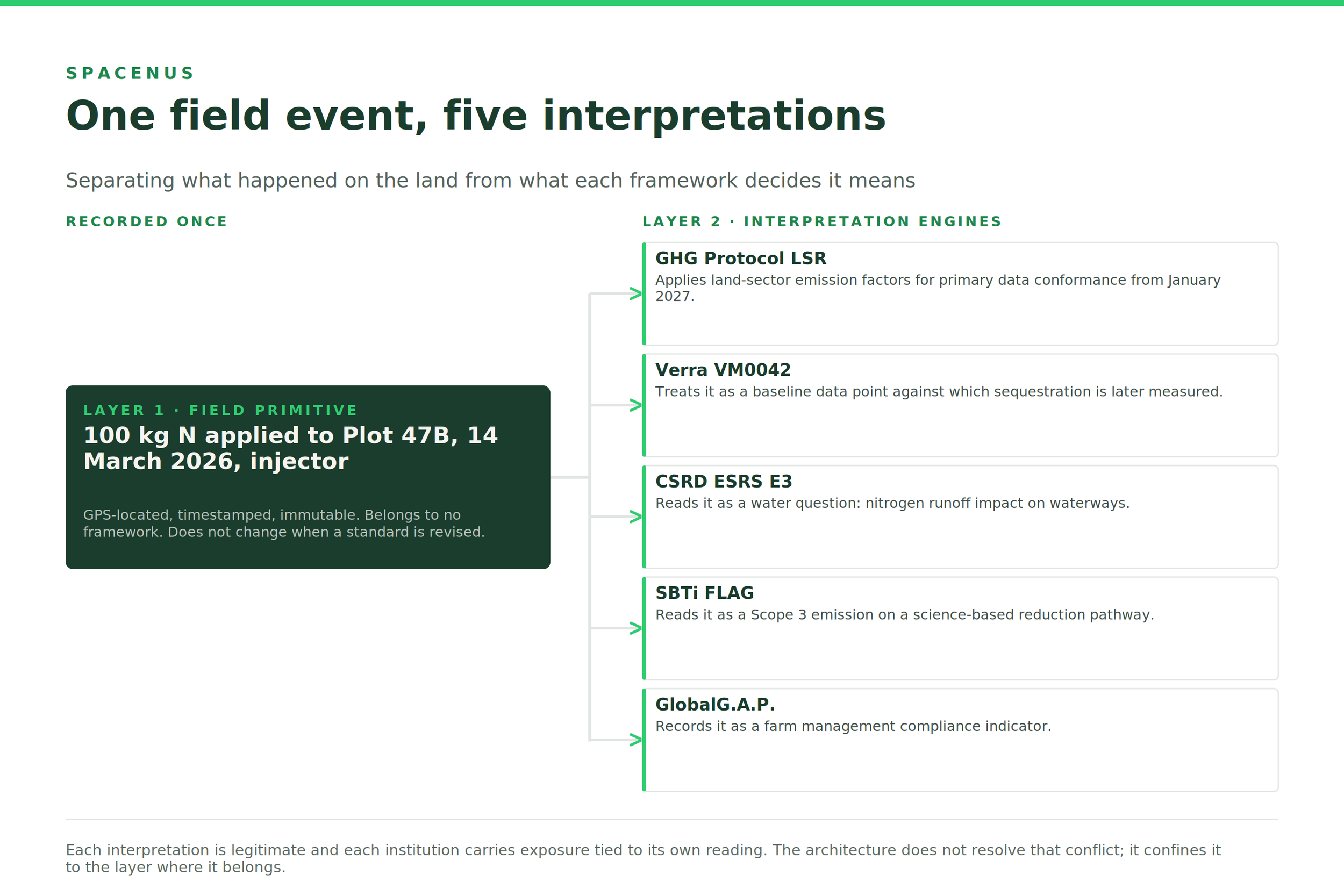
Layer one: the field primitive
A raw, GPS-located, timestamped physical fact. "100 kg of nitrogen applied to Plot 47B on 14 March 2026, injector application." This belongs to no framework. It records what happened on the land. It does not change when a standard is revised.
Layer two: the interpretation engine
Software logic that reads the primitive and calculates what it means for one specific framework. The GHG Protocol engine applies one emission factor. VM0042 applies another. ESRS E3 asks about runoff. Each engine is maintained by, or certified for, the framework it serves.
When a framework revises its methodology, and it will - you update a configuration. You do not send a new questionnaire to ten thousand farms.
“When a standard changes, the right response is to update software, not to re-interview the countryside.” — Spacenus team
The farmer records the application once. The platform translates it into as many frameworks as require it. Satellite observation confirms the boundary and the timing that contextualise it. She does not need to know what FLAG guidance says.
The honest limits
This architecture does not resolve the underlying conflict, and it is worth being clear about what it leaves untouched.
The lender will still want to use the nitrogen figure differently from the regulator. Nothing about better data structure changes an institution’s incentives.
Some fragmentation persists because complexity is commercially useful to parts of the ecosystem. No software removes that.
Granularity is frequently underestimated. The primitive layer has to be detailed enough for the most demanding standard you might ever face. Data collected at ESG-report resolution will not satisfy a plot-level carbon methodology. Collecting at the highest practical granularity from the start is future-proofing, not over-engineering.
What it does is move the problem to where work is possible. Not "the formats differ" - a technical framing with no political solution, but "collection and interpretation are tangled together, and until they are separated the farmer keeps filling in five forms for one field."
What the industry has not built
The missing piece is an open agricultural field-event vocabulary, maintained as shared infrastructure beneath all frameworks. Something comparable to what the WBCSD’s PACT initiative is doing for product carbon footprints.
Several efforts point this way - PACT itself, the Open Ag Data Alliance’s interoperability work, the EU’s Digital Product Passport. None is yet a settled agricultural standard, and they would all benefit from moving faster. The food industry, which carries most of the cost of the current arrangement, has more reason than anyone to push.
It is unglamorous work with no announcement attached. It is also probably the highest-value infrastructure investment available to this sector.
Spacenus is built on this separation. We capture field-level primitives and produce framework-specific outputs from them, as an independent party rather than a programme operator. We would rather the vocabulary underneath were an open standard than a proprietary one, including ours.
Common questions
What is a field primitive?
A raw, GPS-located, timestamped record of a physical event on a specific parcel - an input applied, a crop established, a tillage pass — captured independently of any reporting framework’s interpretation of it.
Why not simply harmonise the standards?
Because the obstacle is not format but purpose. Each framework has legal and commercial exposure tied to its own interpretation of the same fact. Interoperability is achievable in the near term; harmonisation is not.
Does this mean farmers stop filling in forms?
It means they record the event once rather than once per framework. Translation moves to software. That is a large reduction in burden, not its elimination.
What granularity should field data be captured at?
At the resolution demanded by the most exacting standard in your plausible compliance set — typically plot level with timestamps. Aggregated data cannot be disaggregated later, so under-collecting is the expensive mistake.