
Sustainability Reporting: When Measurement Defines Reality
Sustainability has moved from communications into the financial function, which is progress. The accompanying risk is that it comes to mean whatever can be audited rather than whatever is environmentally material, producing strong carbon disclosure and thin data on biodiversity, soil health and rural resilience. Institutional logic favours auditable secondary data over accurate primary data. GHG Protocol LSR removes that trade-off from 1 January 2027 by requiring primary field-level data with spatial traceability.
What changed
Sustainability followed the money into the room where money decisions are made. CSRD reporting obligations, sustainability-linked lending and ESG-adjusted insurance pricing made environmental performance financially material in a way it had not been.
To influence board decisions you have to speak the language of the board, and that language is financial. So sustainability leaders learned to translate: carbon into cost, water scarcity into supply chain exposure, biodiversity risk into asset impairment. The translation is genuinely valuable. Something is nonetheless lost in it.
Assurance answers a narrower question than people assume
Audit assurance answers whether you measured correctly. It does not answer whether you measured the right things.
That distinction is easy to lose once reporting becomes the organising activity. A company can hold a clean assurance opinion on a set of figures that omits most of what its operations actually do to the environment, and nothing in the assurance process will flag that, because it is not what assurance is for.
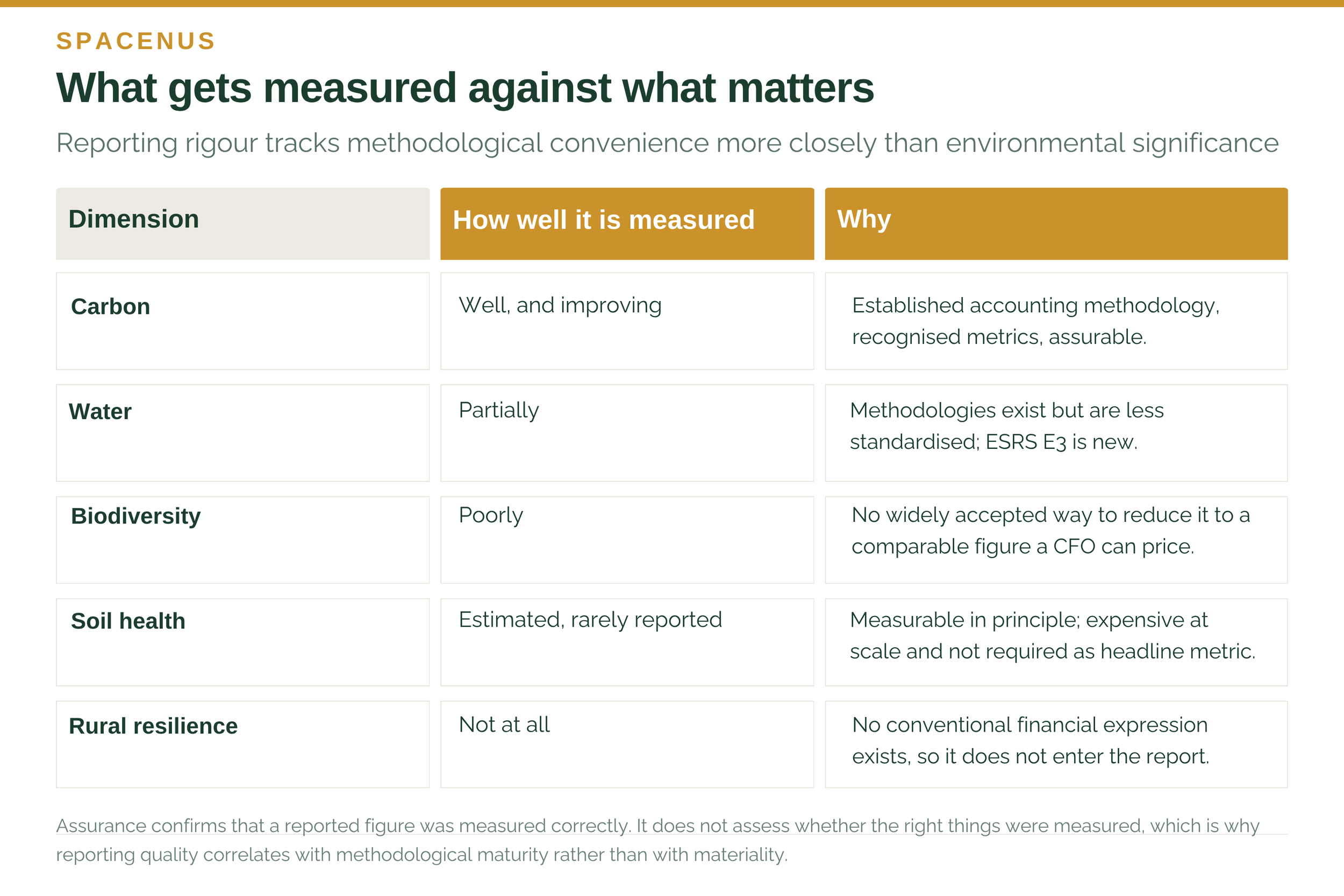
Carbon is measurable, imperfectly but genuinely. Biodiversity is not, in any form easily priced. Soil health can be estimated but not reduced to a single line. Worker welfare can be audited but not straightforwardly costed. The resilience of a farming community that depends on a specific supply chain is not measurable in conventional financial terms at all.
If sustainability becomes synonymous with what can appear in a financial report, companies will report very well on a subset of what matters and not report at all on the rest.
How this shapes what data gets bought
When the primary audience is the CFO and the audit committee, the data commissioned is data that satisfies audit committees: formally assured, expressed in recognised metrics, sourced from documented methodology.
That institutional logic has a specific and slightly perverse consequence. It drives investment toward secondary data and industry averages, auditable even when imprecise, and away from primary farm-level measurement, which is more accurate but historically harder to assure at scale. And it drives investment toward carbon, which has established accounting methodology, and away from water and biodiversity, which do not.
The result is excellent carbon disclosure alongside poor nature data, and supply chain traceability for the top handful of commodities with blind spots elsewhere. Reporting becomes rigorous precisely where rigour is institutionally convenient.
“A number that is auditable but wrong will beat a number that is accurate but unfamiliar, until the accurate one becomes easy to assure.” — Spacenus team
Two conditions that would help
Materiality has to extend past what standards require
CSRD’s double materiality framework, assessing both financial risk to the company and the company’s impact on the environment - is conceptually the right structure. In practice many teams are quietly deprioritising the impact half, because it is harder to put a number on and nobody is scoring it.
That half needs resourcing rather than rounding off, and it needs someone senior asking about it, because the reporting process will not surface its own absence.
Verification has to stay ahead of the reporting requirement
This is the more tractable of the two. While primary farm-level data remains harder to assure than a secondary estimate, companies will keep defaulting to the estimate, not out of cynicism, but because the assured number is the one they can publish.
That changes when satellite verification and passive farm monitoring are accepted by standard bodies and assurance providers as sufficient evidence. The technology is largely there; the acceptance is arriving unevenly. GHG Protocol LSR from 1 January 2027 pushes hard in this direction by requiring primary field-level data for significant land-sector activity — which removes the option of defaulting to averages for exactly the emissions that dominate food sector footprints.
The next milestone
Sustainability moving into the financial function was the right direction. The question is no longer whether it is on the risk register. It is whether the risk register is wide enough, and whether the numbers on it reflect what is happening in the soil rather than what is assumed in an industry spreadsheet.
For anyone building reporting infrastructure now, that suggests a practical test. If your agricultural Scope 3 figure would not change no matter what your suppliers actually did this season, you are reporting an assumption. Assurance will not catch it, and from 2027 the standard will not accept it.
Spacenus produces primary field-level evidence designed to be assurable, with stated uncertainty, spatial traceability and independent verification. We are not an assurance provider and do not sign opinions; we produce the evidence one can be based on.
Common questions
What is double materiality?
The CSRD principle that companies assess both how sustainability issues affect them financially and how their operations affect people and the environment. In practice the second half receives less resourcing because it is harder to quantify.
Why do companies prefer secondary emission factors?
Because they are auditable. A published average applied to a tonnage is easy to assure even though it says nothing about what actually happened. Primary data is more accurate and has historically been harder to verify at scale.
Does GHG Protocol LSR change this?
Yes, for land-sector emissions. From 1 January 2027 it requires primary, field-level data with spatial traceability for companies with significant land-sector activity, which removes secondary factors as a conforming option.
How do you assure primary farm data?
Through independent verification, quantified uncertainty and spatial traceability - satellite time series cross-checked against field evidence, with the methodology and error bounds documented in a form an assurance provider can test.