
Four checks before you invest in a soil carbon project
CSRD Omnibus I narrowed reporting scope in March 2026, but GHG Protocol LSR takes effect on 1 January 2027 and removes secondary emission factors as a conforming option for land-sector Scope 3. The distinction an assurance provider cares about is testability. A national average emission factor gives an auditor nothing to check. A field-level figure with stated uncertainty and a documented sampling design can be traced back to the farm it describes.
Why the question changed
Several years of public criticism of credit quality did what regulation had not managed: it made buyers personally accountable for what they purchased. A sustainability director who buys a credit that is later shown to be worthless does not have a procurement problem, they have a reputational one.
The consequence is a market that has separated. Well-evidenced projects with transparent methodology command a premium and clear quickly. Projects that cannot answer basic provenance questions struggle to sell at all, regardless of price.
Get the market size right first
Before any due diligence, a correction that affects how you size an opportunity. Carbon market figures are frequently quoted at magnitudes that do not correspond to the market being discussed.
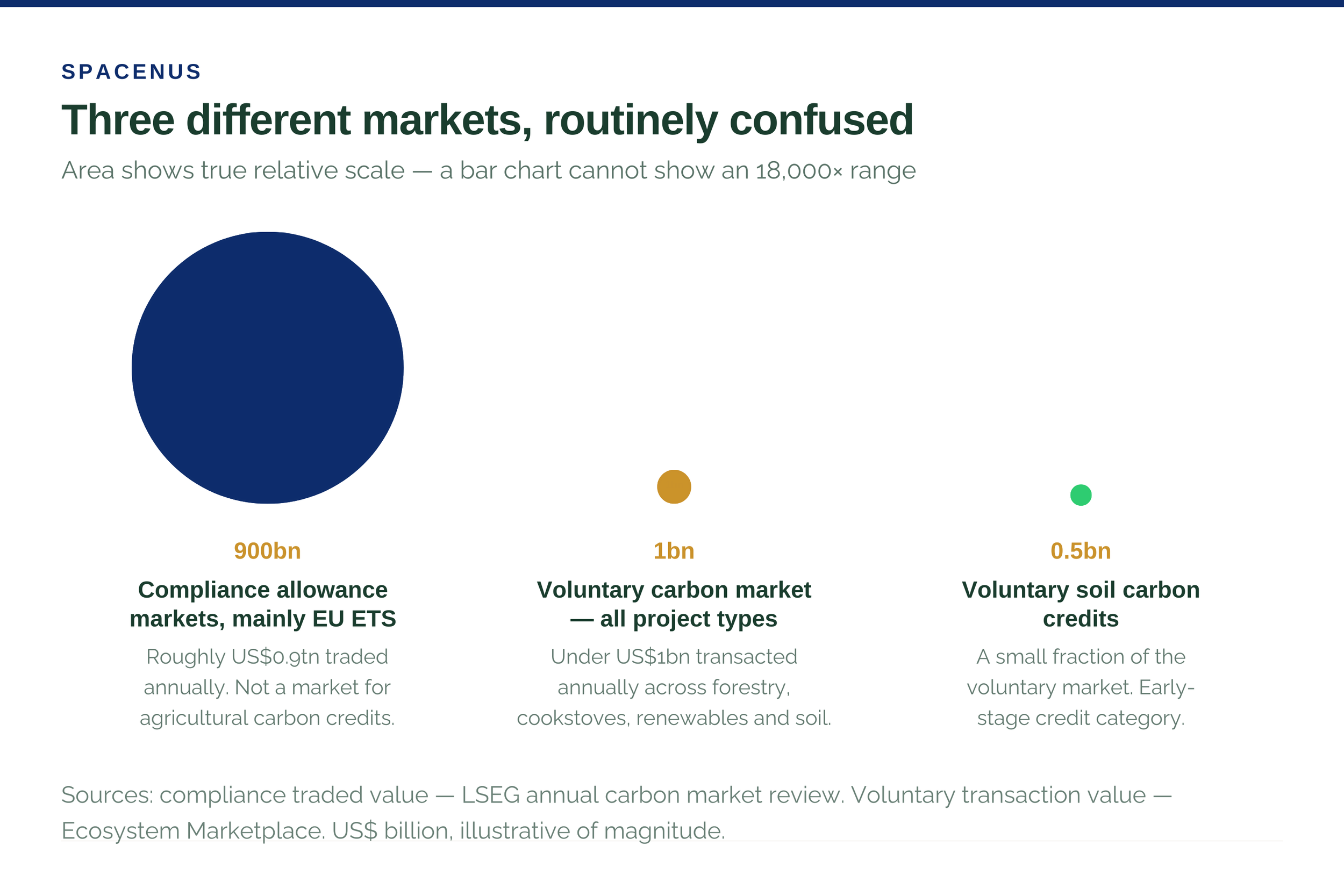
Figures approaching a trillion dollars describe compliance allowance trading, overwhelmingly the EU Emissions Trading System. The voluntary market, where nearly all agricultural and nature-based projects sit, has transacted under a billion dollars annually in recent years. Agricultural soil carbon is a fraction of that again.
This is not an argument against the sector. It is an argument for accuracy, because a business case built on the wrong market will not survive contact with anyone who knows the difference.
The four checks
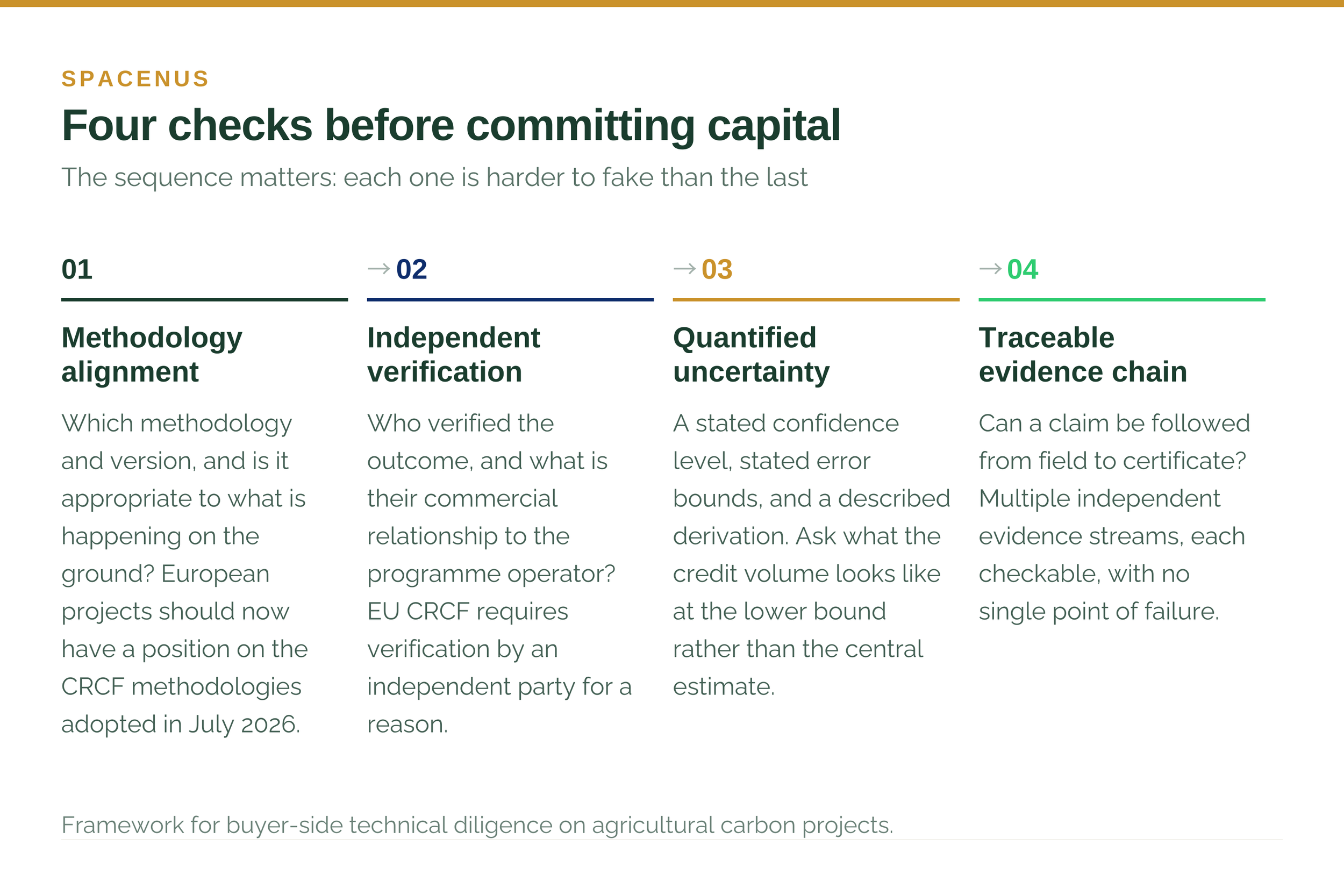
1. Methodology alignment
Which methodology does the project apply, and is that methodology appropriate to what is actually happening on the ground? A soil carbon project should name its methodology, Verra VM0042, a CRCF methodology, Gold Standard - and be able to explain which version and why.
The July 2026 adoption of the first CRCF carbon farming methodologies matters here. European projects now have a certification pathway that did not operationally exist a year ago, and buyers with European exposure should expect projects to have a position on it.
2. Independent verification
Who verified the outcome, and what is their relationship to the entity that designed and operates the programme? This is the question that separates credible projects most sharply, and it is the one most often answered vaguely.
An operator that recruits farmers, designs the programme, issues the credits and verifies the results has a financial interest in the verification passing. That is not an accusation of bad faith; it is a structural conflict that the EU CRCF explicitly addresses by requiring verification to be carried out by an independent party. If a project cannot name an independent verifier, that is a finding.
3. Quantified uncertainty
Every carbon estimate has error bounds. A project that reports a single number without them has either not calculated the uncertainty or has chosen not to publish it, and neither is reassuring.
What good looks like: a stated confidence level, a stated minimum detectable change, and a description of how the uncertainty was derived. Ask what happens to the credit volume at the lower bound rather than the central estimate.
4. A traceable evidence chain
Can you follow a claim from the field to the certificate? For a practice-based project, that means being able to see what evidence establishes that the practice occurred, when it was captured, and whether it could have been altered after the fact.
Satellite time series, geotagged and timestamped field evidence, and spatial cross-validation against comparable land each provide something the others do not. A single stream, however good, is a single point of failure.
Practical questions to put in writing
Which methodology and version, and is the project registered or in the pipeline?
Who performed verification, and what is their commercial relationship to the project developer?
What is the stated uncertainty, at what confidence level, and what is the credit volume at the lower bound?
What evidence establishes that the practice occurred, and can it be independently re-checked?
If this project were challenged publicly in two years, which document would you point to?
That last question is the useful one. It forces a project to identify the single artefact its credibility rests on, and the answer is often revealing.
Where this is heading
Requirements are tightening in a predictable direction. Registries are asking for more tamper-resistant practice evidence. The GHG Protocol Land Sector and Removals Standard, effective 1 January 2027, requires primary field-level data with spatial traceability for companies with significant land-sector activity. Buyers who build their diligence around those requirements now will not have to rebuild it.
Spacenus provides independent verification for carbon programmes operated by others. We issue no credits and run no programmes, so we are not a party to the projects a buyer might be assessing. If you want a technical view on a project’s MRV before you commit, that is a conversation we are happy to have.
Common questions
What is the difference between a removal and an avoidance credit?
A removal credit represents carbon taken out of the atmosphere and stored, for example in soil or biomass. An avoidance credit represents emissions that did not occur. Buyers have increasingly favoured removals because the counterfactual in avoidance is harder to evidence.
Does CRCF certification make a credit safe to buy?
It provides a certification pathway with independent verification and defined permanence provisions, which addresses several common failure modes. It does not remove the need for diligence on the specific project.
How much should verification cost?
For soil carbon, conventional approaches have consumed 25-50% of project budgets. Satellite-guided approaches have reached around 4% of projected credit revenue in ESA pilot conditions. Very low verification cost with no explanation of method is as much a warning sign as very high cost.
Can I rely on a project developer’s own reporting?
You can read it, but the point of independent verification is that the party producing the evidence does not benefit from the conclusion. Ask who checked it and what their stake is.