
What makes agricultural GHG accounting audit-ready?
The reporting obligation moved in 2026 and most agricultural Scope 3 guidance has not caught up. This piece sets out what actually applies after CSRD Omnibus I narrowed scope in March, what GHG Protocol LSR requires from January 2027, and what separates data an assurance provider will accept from data they will not, because a national average emission factor gives an auditor nothing to test, while a field-level figure with stated uncertainty can be independently checked.
What actually applies now
Guidance written before 2026 tends to treat CSRD as a near-universal obligation. That is no longer accurate, and repeating it damages your credibility with the people you are trying to persuade internally.
CSRD Omnibus I has been in force since 18 March 2026 and narrowed scope substantially, to companies above 1,000 employees and above €450 million turnover, with Wave 2 reporting deferred. Companies that were preparing for imminent CSRD reporting may now have more time than they planned for, and some are out of scope entirely.
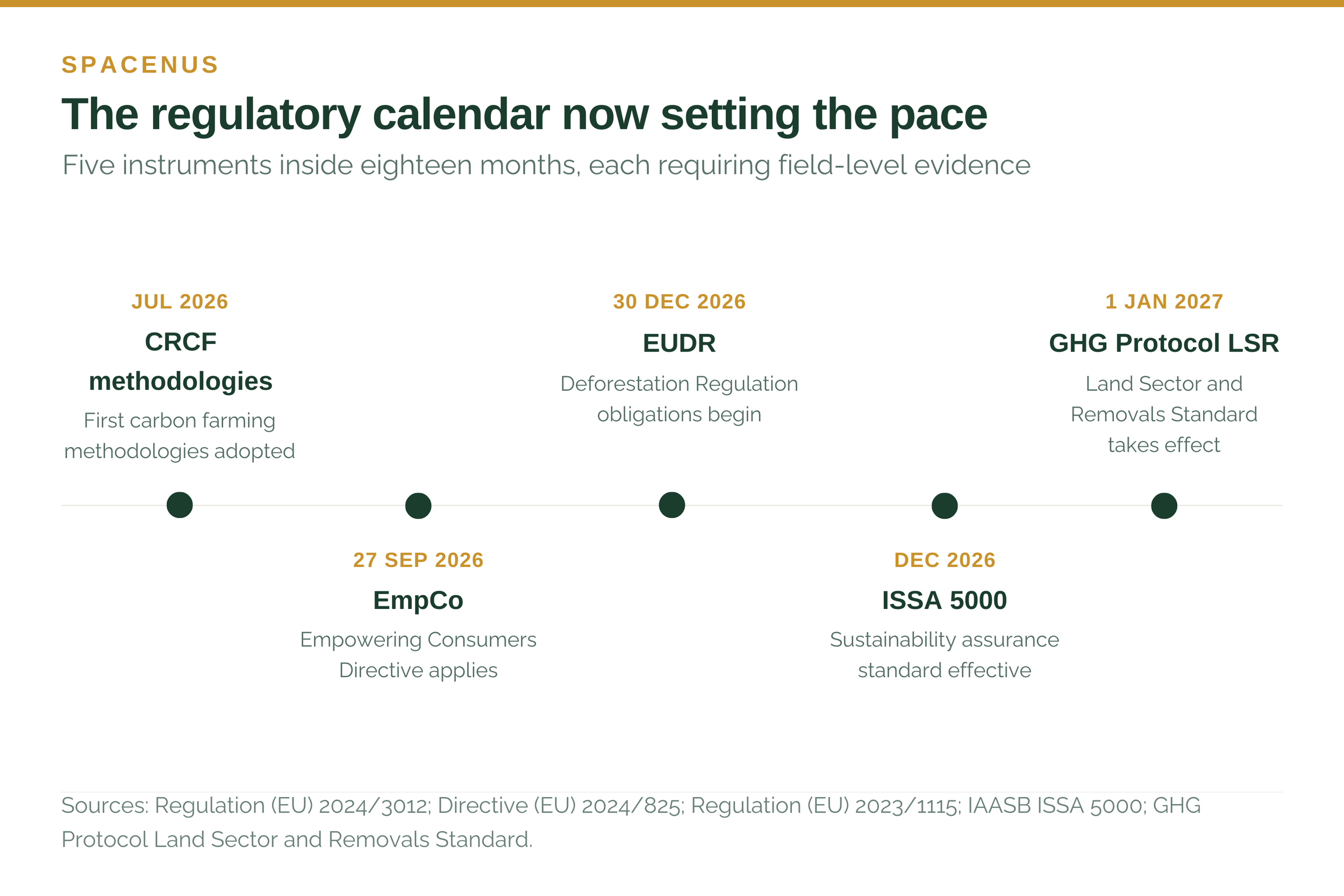
That has been widely misread as a reprieve. It is not, because three other instruments arrive on schedule and none of them were affected.
The three that matter
GHG Protocol Land Sector and Removals Standard - 1 January 2027
This is the one that changes agricultural Scope 3 specifically. LSR requires companies with significant land-sector activity to account for land emissions and removals using primary, field-level data with spatial traceability. Secondary emission factors do not conform.
It also matters for target-setting: SBTi FLAG submissions from 2027 are expected to align with LSR. A company setting a FLAG target on secondary data is building on a foundation that will be withdrawn.
EmpCo - 27 September 2026
The Empowering Consumers Directive applies from late September 2026 and restricts generic environmental claims that cannot be substantiated. If a product carries a regenerative or low-carbon claim, the substantiation has to exist and has to be specific. This is the instrument most likely to create a near-term problem for marketing claims that outran the evidence.
ISSA 5000 - December 2026
A general standard for sustainability assurance engagements. Its practical effect is to make assurance providers more consistent and more demanding about evidence quality, which raises the bar on exactly the agricultural data that has historically been weakest.
What an assurance provider is actually looking for
It is worth being precise about this, because "auditors want primary data" is true but not actionable. What limited assurance requires is that the provider can form a conclusion that nothing has come to their attention suggesting the figure is materially misstated. To do that they need to be able to test something.
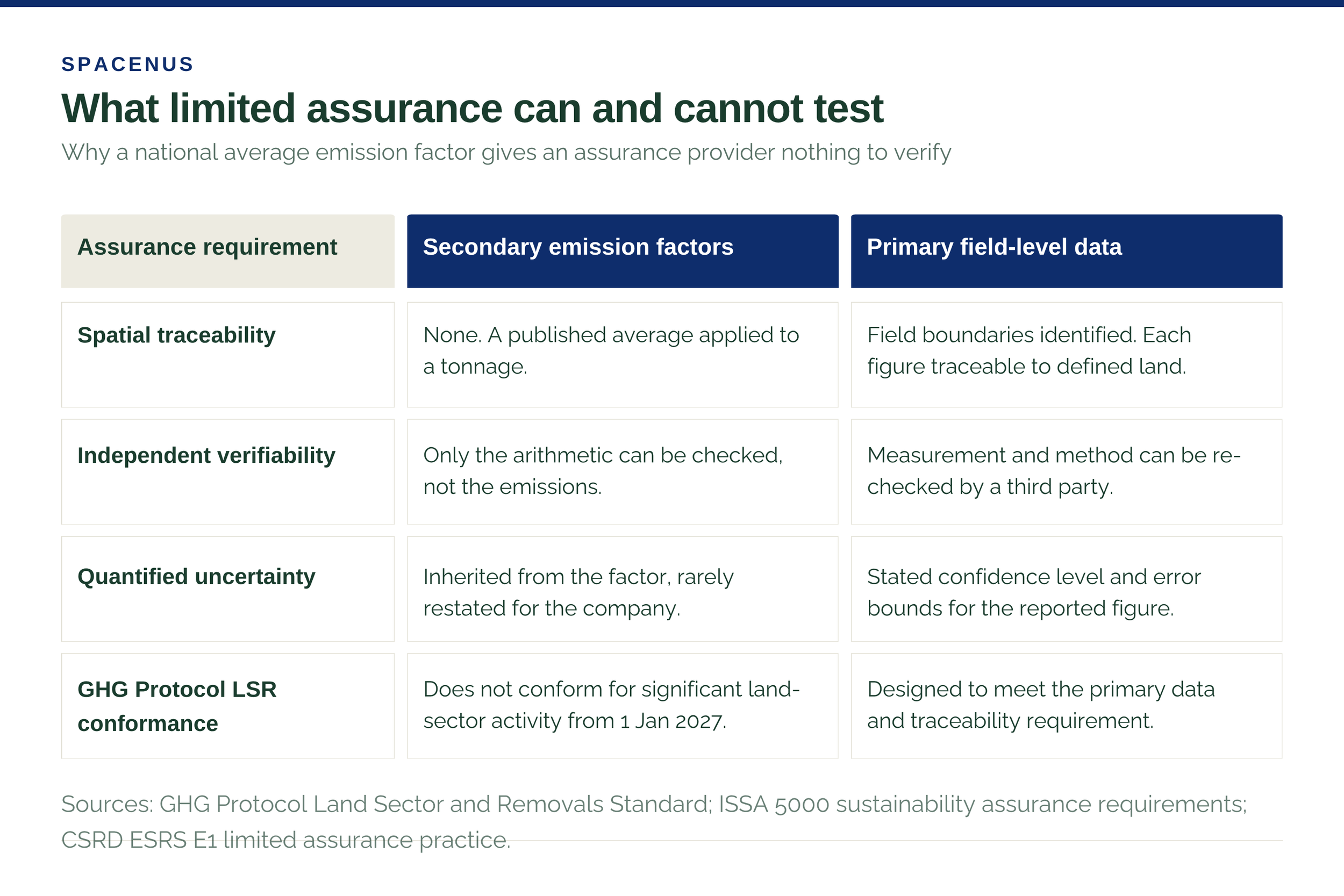
A national average emission factor offers nothing to test. It is a published number applied to a tonnage. The only thing an assurance provider can check is whether the multiplication is correct, which tells them nothing about whether the emissions occurred.
What a defensible evidence chain looks like
The requirement is that a claim can be followed from the field to the reported figure, with each link independently checkable.
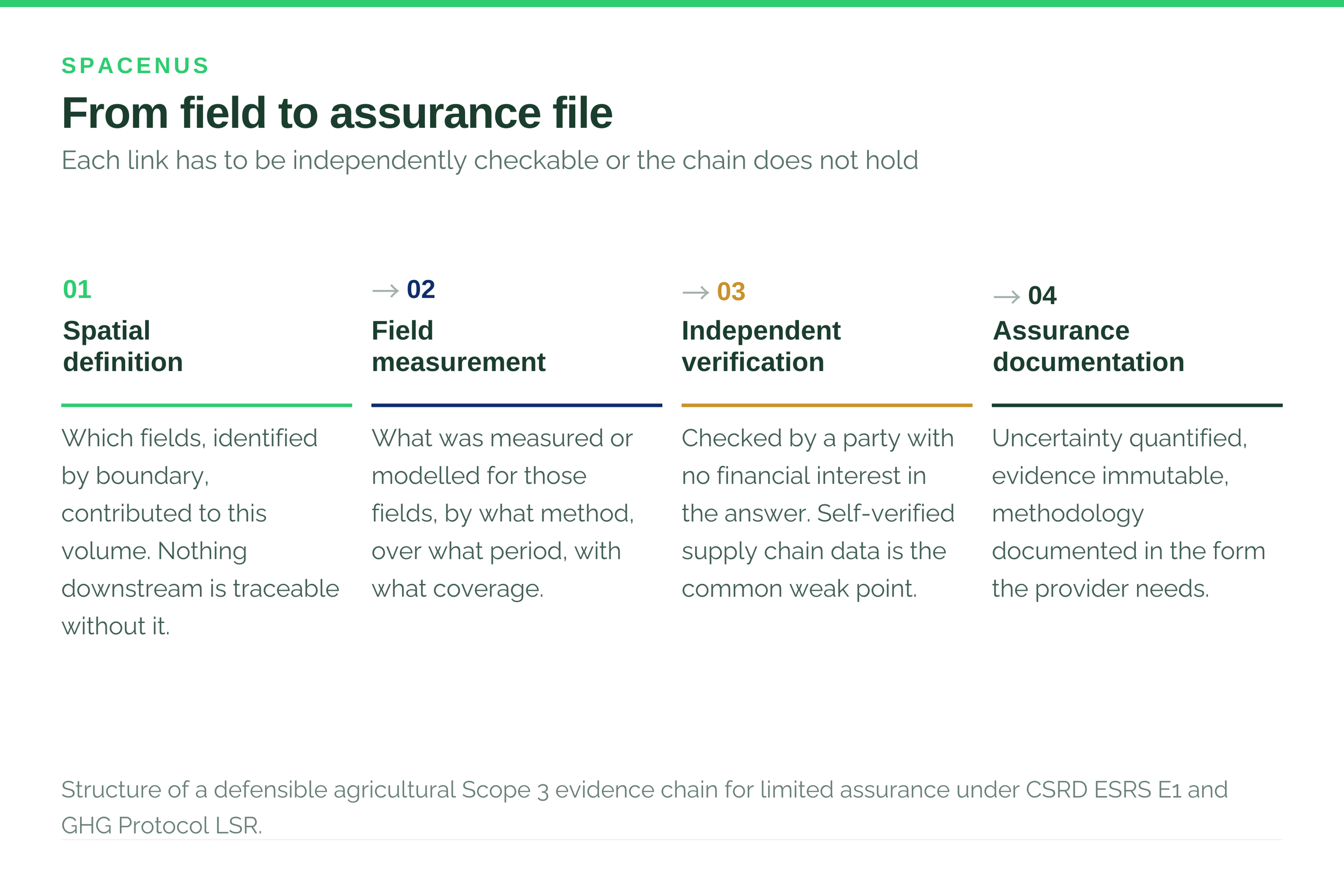
Spatial definition. Which fields, identified by boundary, contributed to this volume. Without this, nothing downstream can be traced.
Field-level measurement. What was measured or modelled for those specific fields, by what method, over what period.
Independent verification. Who checked it, and what is their relationship to the party that benefits from the answer. Self-verified supply chain data is the weakest common failure.
Quantified uncertainty. A stated confidence level and error bounds. Assurance providers are more comfortable with an honest range than a precise-looking number with no stated basis.
An immutable trail. Evidence that cannot be revised after the fact without that revision being visible.
The farmer problem
Most supply chain data programmes fail before any of this becomes relevant, because they cannot get farmers to participate. A compliance request with no farmer benefit produces low response rates and unreliable answers, and unreliable primary data is arguably worse than an honest secondary factor - it looks specific while being wrong.
The approaches that work invert the order: give the farmer something of immediate value, and let the data arrive as a by-product of them using it. Nitrogen optimisation is the usual entry point because the benefit is financial, immediate and requires no practice change.
“A survey nobody wants to fill in produces data nobody should rely on. If the farmer has no reason to engage, you are not collecting evidence - you are collecting a liability that looks like evidence.” — Spacenus agronomy team
What to do in the time remaining
Establish whether LSR applies to you. Significant land-sector activity is the test, not whether you consider yourself an agricultural company. Most food companies and retailers qualify.
Identify which supplier farms account for the majority of your agricultural Scope 3. Coverage does not have to be complete in year one, but it has to be defensible and explained.
Check whether any current public claim would satisfy EmpCo substantiation requirements from late September. This is the nearest deadline and the easiest to overlook.
Ask your assurance provider now what they would need to see. They would generally rather advise early than decline late, and the answer will shape what you build.
Spacenus builds primary field-level evidence for food companies and agribusinesses through RegenScope3, as an independent party rather than a programme operator. That independence is what allows the same evidence to be used by you, your suppliers and your assurance provider without anyone having to take a supplier’s word for it.
Common questions
Does CSRD still apply to my company?
It depends on size after Omnibus I, which narrowed scope to companies above 1,000 employees and €450 million turnover from 18 March 2026. Even where CSRD no longer applies, GHG Protocol LSR from January 2027 and EmpCo from September 2026 are unaffected.
Can I use secondary emission factors for agricultural Scope 3?
For LSR conformance from 2027, no - the standard requires primary field-level data for significant land-sector activity. For general reporting, secondary factors remain usable but are increasingly difficult to defend under limited assurance.
How much of my supply chain needs primary data?
Standards expect a defensible, explained approach rather than complete coverage from day one. Prioritising the suppliers and commodities that dominate your land-sector footprint is normally the sound starting point.
What is the difference between limited and reasonable assurance?
Limited assurance is a negative conclusion, nothing came to the provider’s attention suggesting material misstatement. Reasonable assurance is a positive opinion and requires substantially more evidence. Most sustainability reporting currently sits at limited assurance, with a direction of travel towards reasonable.