
What soil carbon MRV actually costs - and what cannot get cheaper
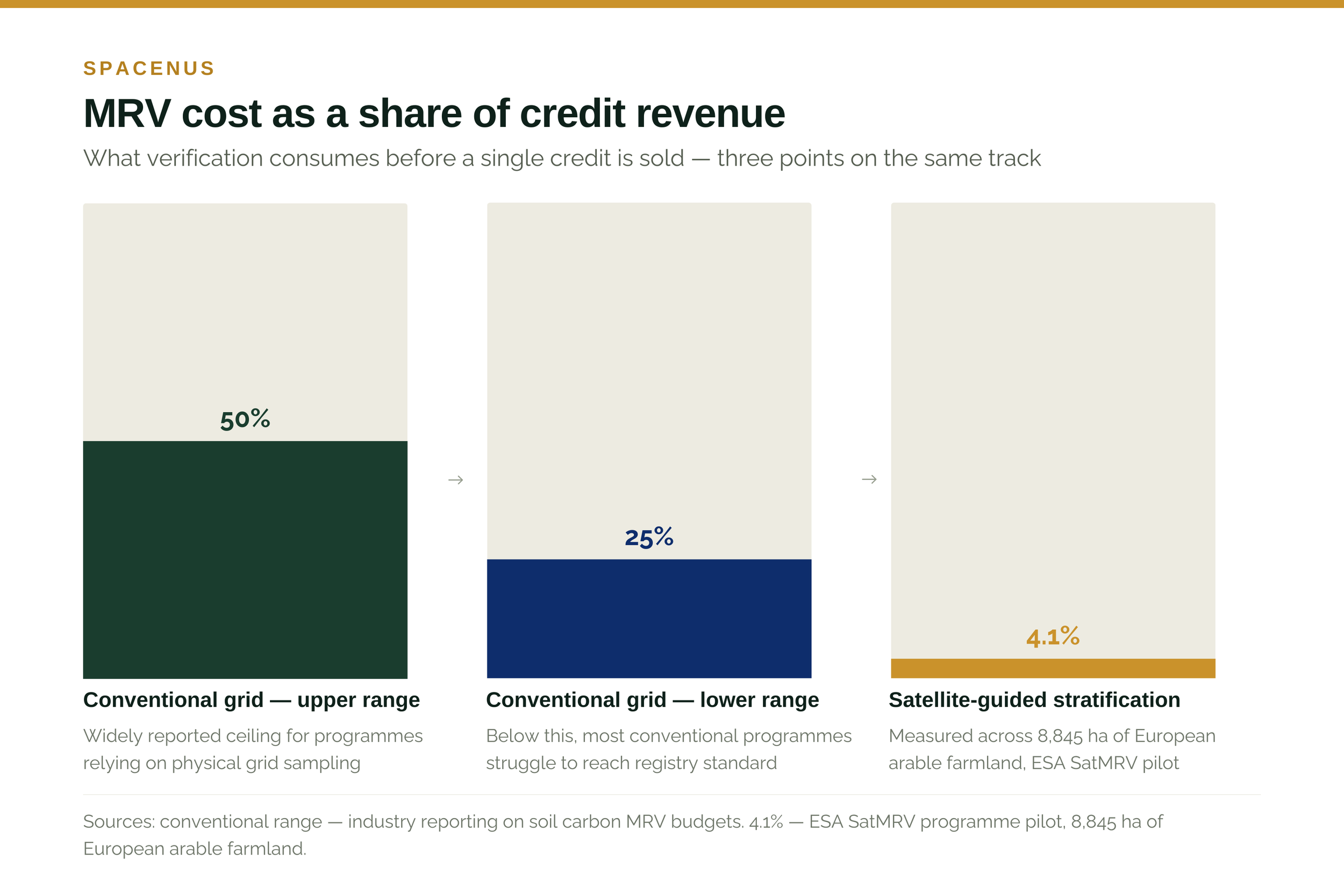
Verification typically consumes 25 to 50% of a soil carbon project's budget in the programmes Spacenus has assessed. Across 8,845 hectares of European arable farmland in the ESA SatMRV programme, satellite-guided stratified sampling brought verification to 4.1% of projected credit revenue. The saving comes from sampling design rather than from measuring less carefully. Bulk density and equivalent soil mass still require physical measurement and do not get cheaper, which is why cost per sample is the wrong basis for comparing providers.
Why MRV cost decides which programmes exist
A soil carbon programme has two costs that matter. One is what you pay farmers. The other is what you pay to prove the carbon is there. The second one determines whether the first one is possible.
At 25–50% of budget, verification does not simply reduce margin. It sets a floor on programme size, because the fixed cost of a defensible sampling campaign has to be spread across enough hectares to make sense. Below that floor, programmes are designed around what can be afforded to measure rather than what would be scientifically appropriate, and that is where registry problems begin.
This is not a technology gap. The soil science is settled and the registry methodologies exist. It is a cost structure problem, and cost structure is a design question.
Where the money actually goes
Conventional grid sampling distributes sample points evenly across a field regardless of what is underneath them. That is statistically honest and operationally expensive, because most of those samples land in ground that behaves like ground you have already sampled.
Field collection. A technician walks a defined grid. Labour scales close to linearly with area, which is precisely what you do not want when scaling a programme.
Laboratory analysis. Each sample is dried, sieved and analysed. Turnaround is typically several weeks, and cost scales directly with sample count.
Repetition. Baselines are re-measured on a defined cycle. A sampling design that is expensive once is expensive every cycle for the life of the project.
The compounding matters more than the headline figure. An inefficient design is not a one-off cost; it is a recurring liability attached to every future verification event.
What stratification changes
Stratification divides a field into zones that are likely to behave similarly in terms of soil organic carbon, then samples across those zones rather than across the map. Each sample carries more information, so fewer are needed for the same statistical confidence.
The inputs are Sentinel-2 time series, terrain models, and available regional soil data. The output is a sampling plan that says where to sample and how many samples are required to detect a specified change — for example a 0.1% shift in soil organic carbon at 95% confidence. The confidence requirement is set first; the sample count follows from it.
This is the important distinction. Stratification does not lower the evidentiary standard. It removes redundant samples while holding the standard fixed.
What it cost in practice
The ESA SatMRV programme ran verification pilots with multiple independent carbon programme developers across 8,845 hectares of European arable farmland. The figures below are measured results from that programme, not modelled projections.
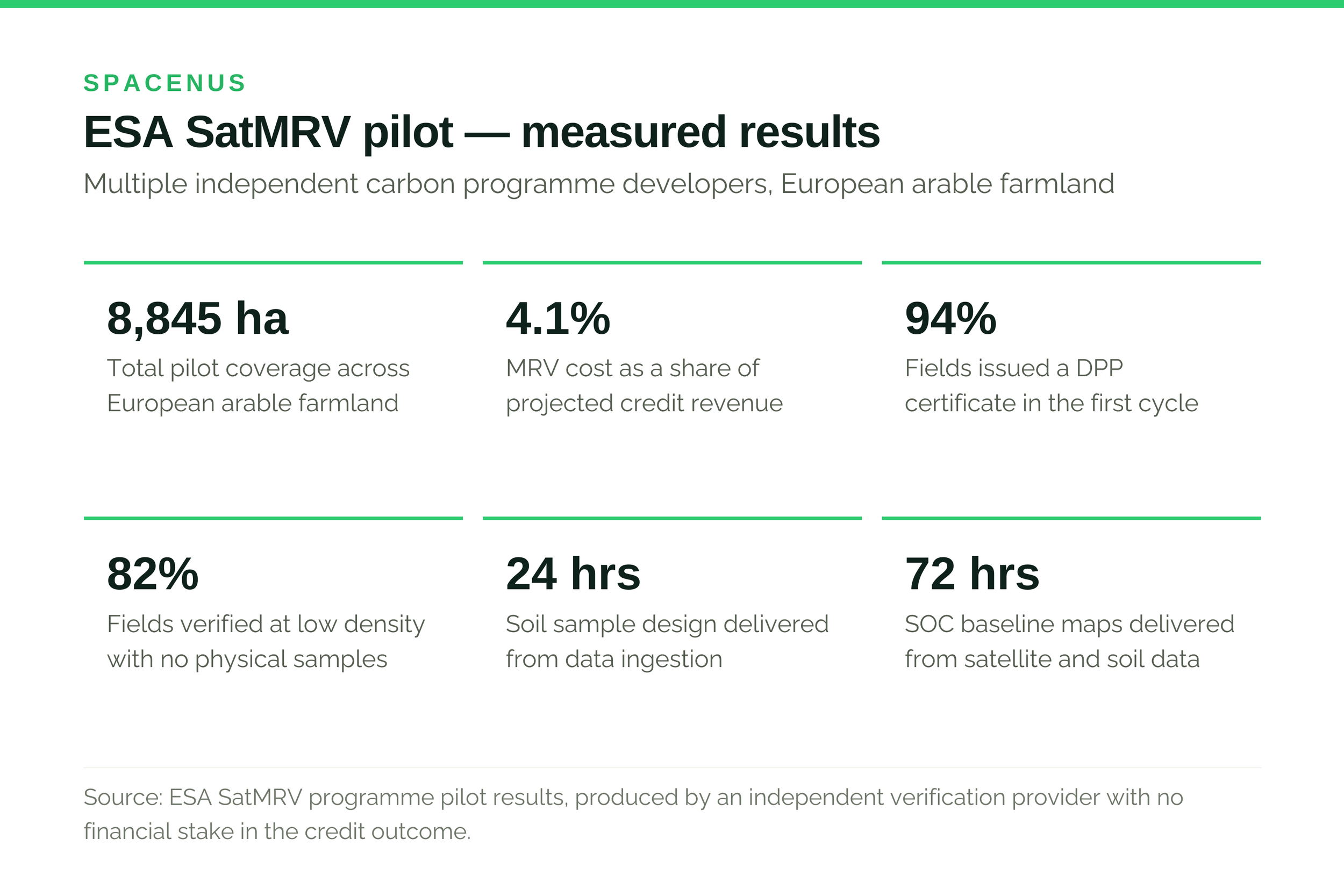
Two of these deserve comment. The 82% figure — fields verified at low-density locations with no physical soil samples — is what makes the cost structure work, and it is only defensible because those fields sit inside a stratification that was itself validated against sampled locations. The 94% first-cycle certificate rate matters for a different reason: fields that do not pass are escalated for review rather than averaged into a portfolio number.
What does not get cheaper
Three things resist optimisation, and any provider who tells you otherwise is worth questioning.
Bulk density and equivalent soil mass. Converting carbon concentration to carbon stock, and comparing stocks honestly across time, both require physical measurement. Reduced intensity, yes. Eliminated, no.
Local calibration. A model trained on one soil-climate combination does not transfer to another without local samples. Budget for calibration in every new region.
Uncertainty quantification. Registries and assurance providers increasingly want the error bars, not just the estimate. Producing them properly costs something.
The honest version of the cost argument is that stratification removes redundancy. It does not remove the parts of verification that make verification meaningful.
“Stratification removes the samples that were telling us something we already knew. It does not remove the ones that keep the result honest — and a provider promising otherwise is selling you a cheaper number, not a better one.” — Spacenus agronomy team
What this means for programme design
If verification cost falls from a quarter of budget to single figures, the constraint on programme size changes. Projects that were unviable at 2,000 hectares become viable. Smallholder aggregations that could never carry a conventional sampling campaign become reachable.
It also changes who can credibly do the verifying. Under the EU Carbon Removal Certification Framework, certification requires verification by a party independent of the entity operating the programme. When verification was expensive, integrated operators had a structural incentive to keep it in house. When it is affordable, that argument disappears — and the independence requirement becomes straightforward to meet rather than a cost to be absorbed.
Spacenus runs SatMRV as an independent verification service. We do not issue credits and we do not operate carbon programmes, so we have no financial interest in whether a given field passes. If you want to see what stratification does to your own programme economics, we will run the numbers on your fields before you commit to anything.
Common questions
Does stratified sampling meet registry requirements?
Stratified sampling design is an accepted approach under Verra VM0042 and is compatible with EU CRCF verification requirements. The requirement is statistical validity at a stated confidence level, not a prescribed sample count.
How is 4.1% calculated?
It is total verification cost expressed as a share of projected credit revenue for the pilot area, measured across 8,845 hectares of European arable farmland in the ESA SatMRV programme.
Does this work outside Europe?
The method transfers; the calibration does not. Regions with dense existing soil datasets need fewer calibration samples. Data-scarce regions need more, and the cost advantage is smaller in the first project cycle.
Can satellite data replace soil sampling entirely?
No. It changes what samples are for — from estimating an average to validating a spatial model — and reduces how many are needed. Bulk density and equivalent soil mass still require physical measurement.