
Soil carbon and water: correcting a figure the sector repeats
A widely repeated claim that a 0.1% increase in soil organic carbon holds 200,000 litres of water per hectare is overstated by roughly 57 times. On a soil-mass basis the measured figure is closer to 3,500 litres per hectare. The mechanism is real but smaller than the sector's numbers suggest: soil organic carbon buffers drought and flood, improves nutrient retention and supports yield stability. The CRCF methodologies adopted in July 2026 changed what it costs to prove any of it.
Start with an honest number
Soil carbon writing has a credibility problem, and it is worth confronting directly because it undermines the case it is meant to support.
A figure repeated across the regenerative agriculture literature holds that each tonne of soil organic carbon retains four tonnes of water, and that a 0.1% gain in soil organic carbon across a hectare therefore stores an additional 200,000 litres. The second claim does not follow from the first, and neither survives measurement.
Work the arithmetic. One hectare to 30 cm depth is 3,000 cubic metres. At a bulk density of 1.3 tonnes per cubic metre that is 3,900 tonnes of soil, so a 0.1% gain is 3.9 tonnes of carbon. Even accepting the four-to-one ratio, that yields around 15,600 litres, not 200,000.
The measured effect is smaller still. Controlled work on how organic matter affects plant-available water capacity has consistently found the response to be far weaker than popular accounts suggest, putting the realistic figure for a 0.1% soil carbon gain nearer 3,500 litres per hectare.
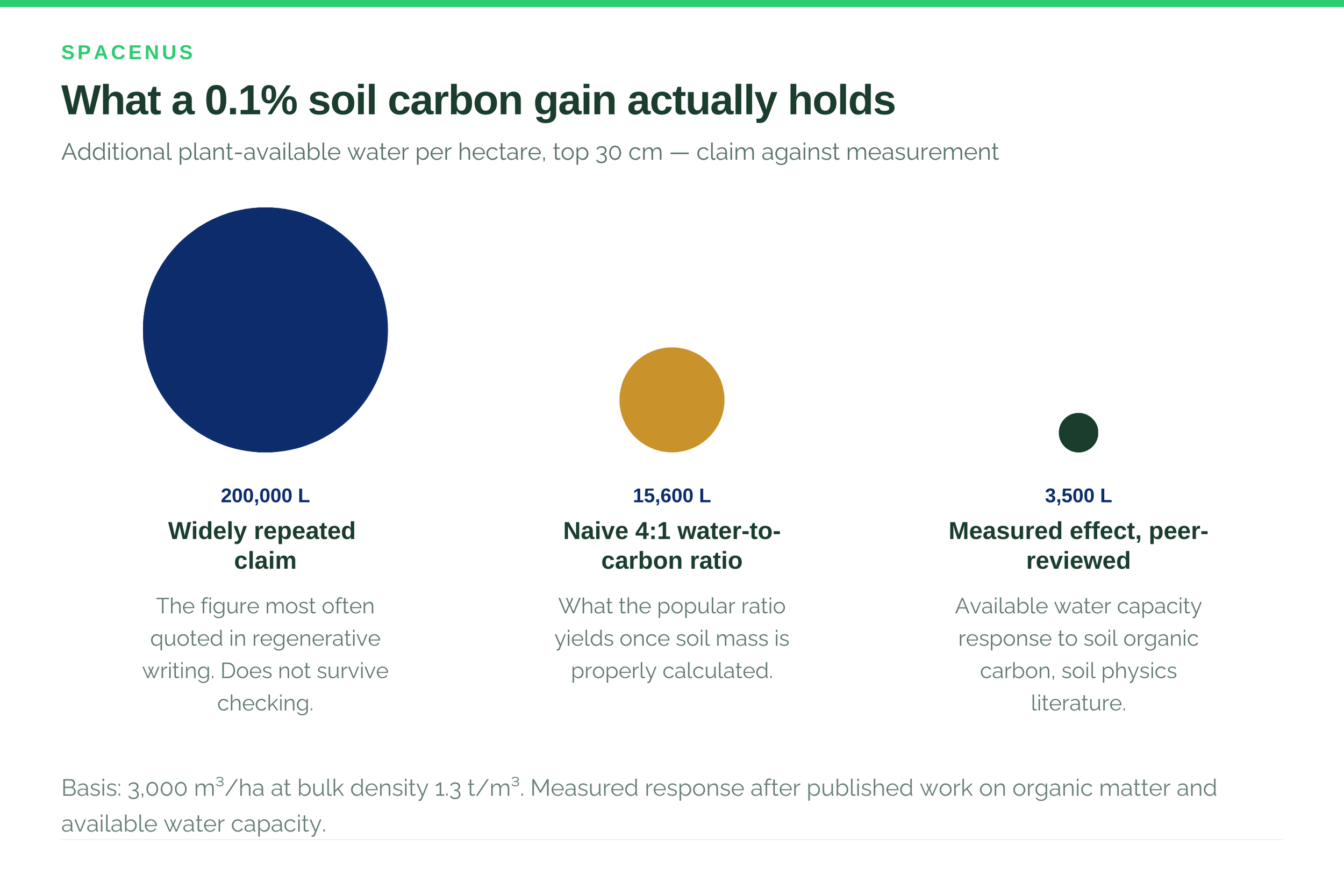
Roughly 3,500 litres per hectare is still worth having, particularly compounded across a rotation and across a catchment. It is simply not a miracle, and the case for soil carbon does not require one. Overstating the mechanism by two orders of magnitude is how a genuine agronomic argument gets dismissed as advocacy.
“The case for soil carbon is strong enough without inflating it. Every time a number like this gets repeated unchecked, it gives someone a reason to dismiss the whole argument, and the argument deserves better.” — Spacenus agronomy team
What soil carbon actually does
The value of soil organic carbon is not principally water storage. It is structure. Carbon-rich soils aggregate better, which improves infiltration during heavy rain and reduces both runoff and erosion. They cycle nutrients more efficiently, reducing dependence on synthetic inputs. They support the fungal and microbial networks that make the rest of it work.
Those effects are harder to express as a single number, which is exactly why the water figure gets over-used. They are also where most of the resilience benefit sits.
The scale of the opportunity is real without embellishment. Soils hold more carbon than the atmosphere and terrestrial vegetation combined, and agriculture has released a substantial share of it, Sanderman and colleagues estimated global losses of around 133 gigatonnes of carbon from soils over roughly twelve thousand years of cultivation. That is a long accumulation, not an industrial-era event, and reversing even part of it is a multi-decade undertaking.
Why measurement was the barrier
If soil carbon is this valuable, the obvious question is why it is not already being rewarded at scale. The answer is that until recently it could not be measured affordably enough to pay for.
Conventional assessment means physical cores, drying, sieving and laboratory analysis. Capturing genuine within-field variability requires enough cores that the cost per hectare becomes prohibitive across Europe’s roughly 157 million hectares of utilised agricultural area. Any scheme that pays for outcomes needs measurement cheaper than the outcome is worth, and for a long time that condition was not met.
Three developments changed the arithmetic, and they work together rather than competing.
Stratified sampling design. Dividing land into zones likely to behave similarly, then sampling across zones rather than across a grid, reduces sample counts at equivalent statistical confidence.
Field spectroscopy. Handheld instruments now estimate soil carbon in situ in under a minute, moving a large share of analytical work out of the laboratory.
Satellite fusion. Combining optical, radar and thermal imagery in machine-learning models extends measured points across whole landscapes. Radar matters particularly, because it penetrates cloud and keeps the time series continuous through a European winter.
In the ESA SatMRV programme, verification across 8,845 hectares of European arable farmland came to 4.1% of projected credit revenue, against an industry range of 25–50% for conventional approaches. That is the threshold change that makes outcome-based payment feasible.
Practices with credible European evidence
Regenerative agriculture is not one method. Three practices have both meaningful carbon effects and demonstrated European uptake.
Reduced and no-till. Less disturbance slows organic matter decomposition and preserves fungal networks. Effects are real but slower and more variable than often claimed, and depend heavily on whether tillage is genuinely eliminated or merely reduced.
Cover cropping. Winter cover between cash crops adds biomass, suppresses weeds and protects soil from erosion. Uptake across Europe has risen sharply, substantially driven by CAP eco-scheme payments.
Organic amendments. Compost, manure and biochar add carbon directly. Biochar is the most durable of the three, though feedstock availability and cost limit how far it scales.
One caveat that honest accounts include and promotional ones omit: soil carbon gains are reversible. A field that accumulates carbon over five years can lose it in one season of intensive tillage. This is why permanence buffers and continuous monitoring exist in credit frameworks, and why a single point-in-time measurement is not evidence of anything durable.
The policy machinery
The Common Agricultural Policy for 2023–27 allocates substantial funding to eco-schemes, many of which pay for practices that build soil carbon. That is money moving on the basis of practice adoption.
The Carbon Removal Certification Framework, in force since December 2024 with its first carbon farming methodologies adopted in July 2026, does something different: it creates a certification pathway for outcomes. It requires third-party verification, permanence provisions and defensible baselines, and it specifies that verification must be independent of the entity operating the programme.
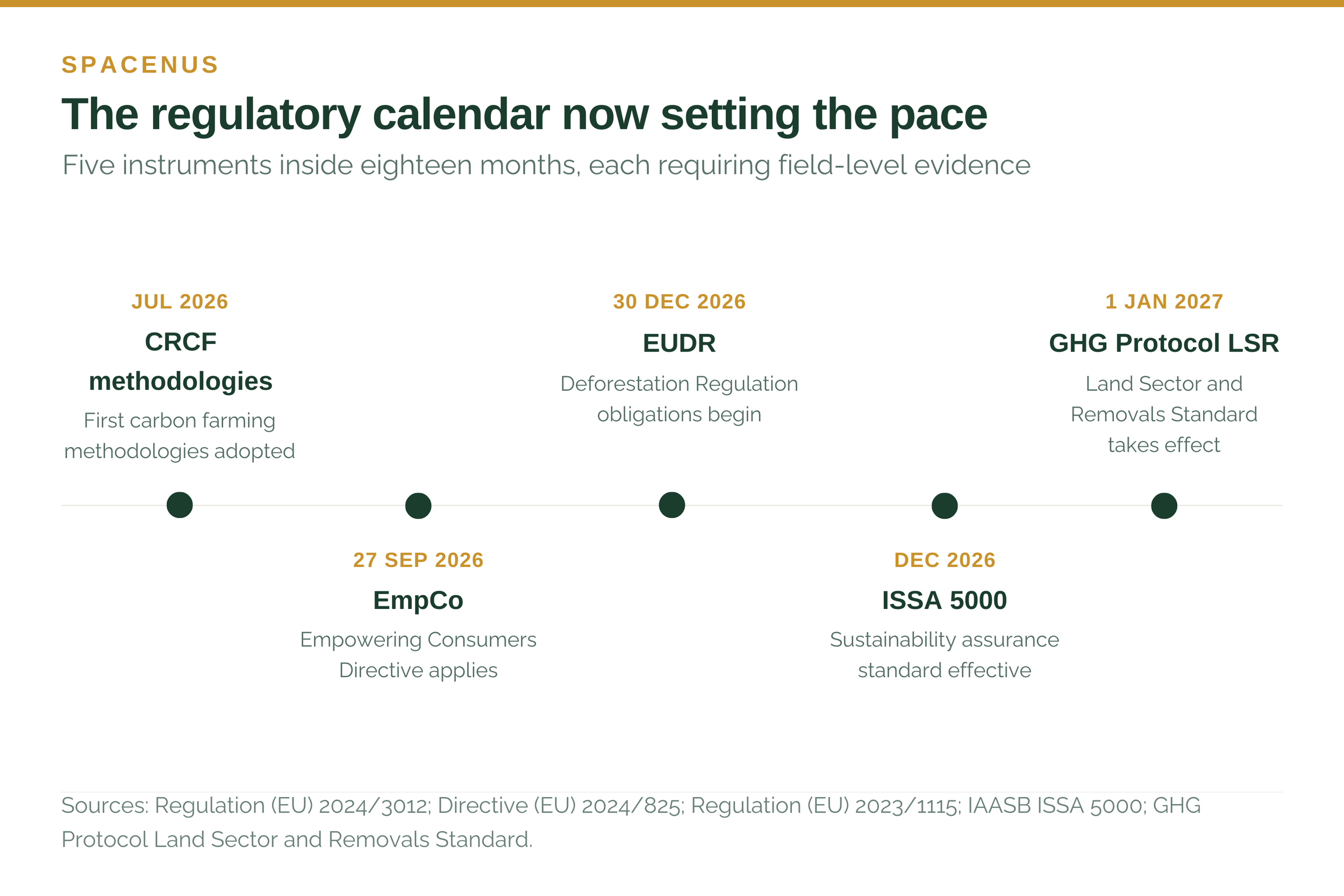
Alongside it, the GHG Protocol Land Sector and Removals Standard takes effect on 1 January 2027 and requires primary, field-level data for companies with significant land-sector activity. That obligation reaches every food company sourcing from European farms, whether or not a single carbon credit is ever issued.
What still needs to happen
Protocol harmonisation. Sampling depth, spectral calibration and uncertainty reporting still vary enough that a credit generated in one member state is not straightforwardly comparable with one generated in another.
Smallholder access. Aggregating many small holdings into a single verification contract is the only route to viable per-hectare cost for the several million European farms below ten hectares.
Transparency. Open repositories where satellite estimates and ground measurements can be cross-checked independently. Trust in this market will be built by verifiability, not by assertion.
Spacenus verifies agricultural sustainability claims for programmes operated by others. We hold no credits and run no farmer programmes, which is what allows the evidence we produce to be used by every party in a supply chain. Where we publish a number, we will show you how it was derived.
Common questions
How much water does soil carbon really hold?
Considerably less than commonly claimed. A 0.1% increase in soil organic carbon in the top 30 cm corresponds to roughly 3,500 litres per hectare of additional plant-available water on measured evidence, not the 200,000 litres frequently quoted. The wider benefits of soil carbon come mainly from improved structure and nutrient cycling rather than storage volume.
What does soil carbon measurement cost now?
It depends on method and region. Conventional MRV has typically consumed 25–50% of soil carbon project budgets. Satellite-guided stratified approaches have brought this to 4.1% of projected credit revenue in ESA SatMRV pilot conditions across European arable farmland.
Is soil carbon permanent?
No, and frameworks treat it accordingly. Accumulated carbon can be released by a return to intensive tillage, which is why permanence buffers, defined monitoring periods and continuous verification are built into credible credit methodologies.
Does CRCF apply to my farm?
CRCF is voluntary. It applies where a project or scheme seeks certification of carbon removals. Its practical significance for most farms is indirect, through the programmes and buyers that choose to require certified units.