
How big is the carbon farming market? Which numbers are real
Carbon farming market projections are consistently optimistic and consistently silent on whether the underlying credits survive scrutiny. Figures near a trillion dollars describe compliance allowance trading, mainly the EU Emissions Trading System, not the voluntary credit market, which is far smaller and is where agricultural soil carbon sits. The two should never be quoted interchangeably. The first CRCF carbon-farming methodologies were adopted in July 2026, and they require an independent verifier that a programme operator cannot supply itself.
The number problem
Almost every article about carbon farming quotes a market size, and a striking number of them quote a figure close to a trillion dollars. That figure is real. It is also the annual traded value of compliance emission allowances - overwhelmingly the EU Emissions Trading System, which has nothing to do with agricultural carbon.
Three markets get conflated, and they differ by roughly three orders of magnitude.
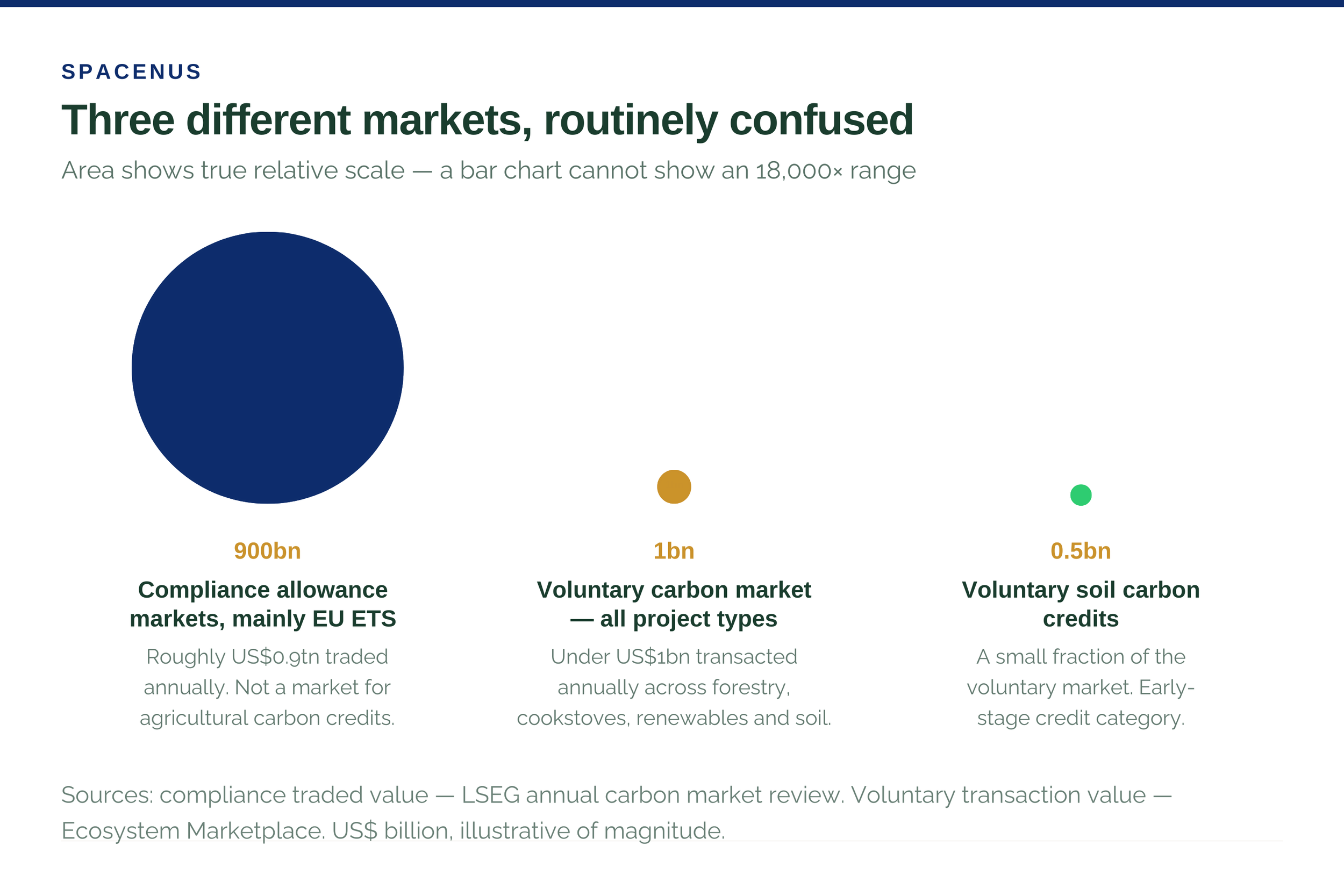
If you are assessing whether a soil carbon programme is commercially viable, the relevant market is the third bar, not the first. Agricultural soil carbon remains an early-stage credit category. Quoting compliance-market totals in a soil carbon business case is not optimism; it is a category error, and any counterparty who spots it will discount everything else in the document.
The market most agricultural verification actually serves
There is a second market that carbon farming forecasts tend to miss entirely, and it is growing faster and more predictably than the credit market.
Food companies and agribusinesses are being required to produce field-level primary data about their agricultural supply chains, not to sell credits, but to satisfy reporting obligations. That demand is priced per hectare under verification rather than per tonne of carbon, and it does not depend on credit prices holding up. For most agricultural sustainability providers, this is the larger and more durable opportunity.
It is also the one with fixed dates attached.
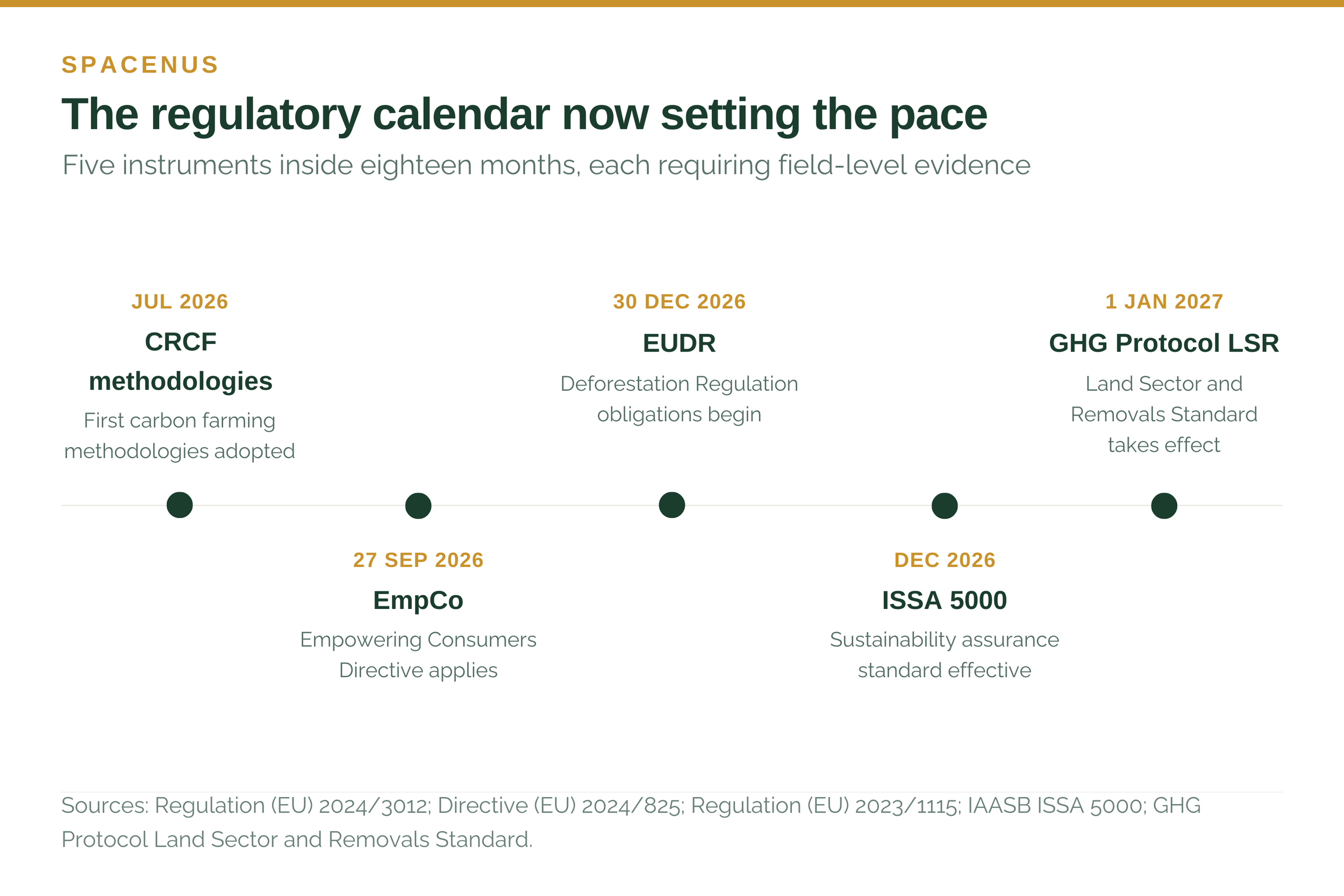
What the CRCF methodologies changed
The EU Carbon Removal Certification Framework was established by Regulation (EU) 2024/3012 and has been in force since December 2024. Until this year it was a framework without operative methodologies, which is to say a promise rather than a mechanism. The adoption of the first carbon farming methodologies in July 2026 changes that.
Two features of the framework matter commercially. It is voluntary, so it is not an enforcement regime and should not be sold as one. And certification requires verification by a party independent of the entity that designed and operates the programme, which means an integrated operator cannot certify its own outcomes.
That independence requirement is the most consequential detail in the regulation for anyone building a carbon farming business. It converts independent verification from a credibility nicety into a structural requirement of the certification pathway.
Demand has shifted from volume to provenance
Corporate buyers spent several years being publicly criticised for credits that did not represent what they claimed. The response has been a flight to quality: buyers now ask what methodology applies, who verified it, what the uncertainty is, and whether the evidence chain would survive an assurance review.
This is why credit prices have separated. Well-evidenced removals with transparent methodology command a premium; generic avoidance credits from opaque projects struggle to clear at all. For carbon farming specifically, it means the cost of good verification is increasingly recovered in the credit price rather than merely subtracted from margin.
What decides whether the forecasts land
Growth projections for carbon farming rest on three assumptions that are worth examining before relying on them.
That verification becomes affordable enough for programmes to reach scale. At a quarter to a half of project budget, most cannot. This is a solvable engineering problem and it is being solved.
That credits survive scrutiny. One high-profile integrity failure in agricultural soil carbon would set the category back years, as has already happened in other credit types.
That the regulatory pathway stays navigable. CRCF methodologies are now adopted, but scheme recognition and registration remain in progress, and forecasts assume a smoother path than the evidence yet supports.
None of these are reasons for pessimism. They are reasons to treat market projections as conditional rather than predictive, and to invest in the conditions rather than the projections.
Spacenus provides independent verification for carbon programmes operated by others. We have no credits to sell and no programme to defend, which is why our reading of this market is not an argument for our own inventory. If you are assessing programme economics, we are glad to look at your numbers with you.
Common questions
How large is the agricultural carbon credit market?
Considerably smaller than headline carbon market figures suggest. Voluntary carbon market transactions across all project types have run under one billion US dollars annually in recent years, and agricultural soil carbon is a small share of that. Figures near one trillion refer to compliance allowance trading, principally the EU ETS.
Is CRCF mandatory?
No. CRCF is a voluntary certification framework. Its commercial force comes from buyers and schemes choosing to require it, and from its independent verification requirement, not from a legal obligation to participate.
What changed in July 2026?
The first carbon farming methodologies under the CRCF were adopted, giving European carbon farming projects an operative certification pathway rather than a framework awaiting detail.
Can a carbon programme operator verify its own programme under CRCF?
No. The framework requires verification by an independent party, which is a structural constraint on integrated operators that design, run and would otherwise verify their own programmes.